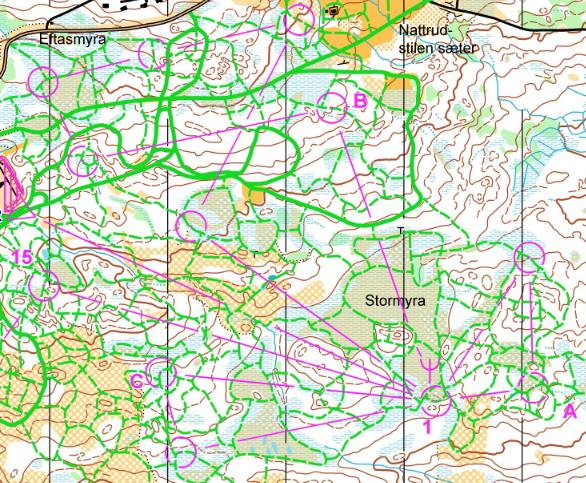
I usually don’t publish half-finished work, but as I’m too busy to finish this off the next few weeks, I thought I’d rather let you get the chance to test this now, and give me some feedback! My initial testing indicates that it is a bit slow on Android – I’m looking into some possibilities there. All feedback is welcome.
Do we currently have a way to make mass start interesting for spectators and TV viewers? Watching the mass start in the European Championships (EOC) in Ski-orienteering on Saturday got me thinking about the topic, as it is well known that there is ongoing work in the “WOC in the future” work group in order to determine if mass start will be on the World Championships (WOC) program for foot-orienteering in the future.
Individual start competitions need to be complemented with formats such as chase and mass starts where first-to-finish is the winner. Such development will introduce new challenges to a traditional concept and address the ambition to further raise the spectator and media values of WOC. [...] Events need to become even more attractive to follow, both live at the arena and through TV and web-cast media. To achieve this, events need to be made easier to understand and appreciated and more exciting to watch.
How would you make a mass start event in orienteering interesting to watch for spectators in the arena or for a TV audience?
Note! These are my personal thoughts about the matter – and I am very much open for input and discussion. I would be grateful for any input – please come up with a good spreading principle for mass start and enlighten me! How would you make a mass start event in orienteering interesting to watch for spectators in the arena or for a TV audience? Note also that one option as to how to introduce a mass start is through a knock-out sprint which is not further discussed in this comment.
Mass start already on the WOC program
In Ski-orienteering, mass start has already been part of the regular WOC and EOC program for some years. Thus it was with great interest I sat down on Saturday to watch the live coverage from the EOC ski-o mass start. Maybe there is something to learn from the experiences in ski-orienteering? How does the spreading work? Is it interesting to watch? As I don’t know the sport as well as foot-orienteering, I thought I’d see it a bit more from the outside.
EOC ski-o: Great live coverage
The live coverage from the EOC was great for a ski-orienteering event – GPS-tracking, video feed, live results and LiveBlog. According to the statistics there were between 500 and 700 unique viewers on the video feed each of Saturday and Sunday – and around 1400 TV hours watched in total. The video feed did only have cameras at the finish to go along with GPS tracking and results boards + speaker sound, but although more cameras would have made the broadcast better, I don’t think it would have changed my overall impressions regarding the mass start concept chosen.
Women: Nothing for 30 minutes
… watched for the first 30 minutes of the 40 minute race without knowing anything about the outcome
The mass start event at the EOC ski-o was a middle distance event (at WOC ski-o the mass start is at the long distance event). For the women that means a winning time of around 40 minutes. The course layout was as follows (see GPS-tracking here – see also map showing the three-winged butterfly above):
A long leg to the first control which was the same for all competitors (around 4 minutes skiing time)
Three butterfly wings with different length from this first control – length of the wings were around 4, 6 and 16 minutes.
Around 10 minutes with common controls in the end
I tried to follow the GPS-tracking closely in order to understand who was in the lead, but for me it was impossible to find out the standings until the end of the three-winged butterfly. The commentator didn’t even try to figure out who was in the lead either as far as I could hear, so we both (along with all other spectators) watched for the first 30 minutes of the 40 minute race without knowing anything about the outcome. Then, after 30 minutes of “mystery”, 2 competitors – Tatyana Kozlova and Marthe Renaas – emerged together with a lead of about 40 seconds – ready for 4 common controls towards the finish. Luckily for the competition, there was some excitement around the second last control as Kozlova made a mistake. Finally Renaas took a relatively clear victory.
Men: Better – but still not what we are aiming for?
The men’s course was a bit longer (see GPS tracking part 1 and part 2) – with a winning time of around 48 minutes. A similar course layout to the women in the start, but then an extra loop in the end:
A long leg to the first control which was the same for all competitors (around 3 minutes skiing time)
Three butterfly wings with different length from this first control – length of the wings were around 4, 5 and 12 minutes (see map with butterfly above – approximately the same as for the women)
Around 7 minutes with common controls to a map exchange/spectator control
Around 3 minutes with common controls to a new butterfly, this time with two wings
Around 8 minutes for the two butterfly wings (see map below)
Another 6 minutes with common controls to the finish
Unfortunately I left the ski-orienteering for another TV-channel (cross country skiing)
For the men there was thus around 24 minutes of “mystery time” in which it was impossible to know who was in the lead. Then Staffan Tunis emerged first after the three-winged butterfly with Erik Rost not far behind. Unfortunately I left the ski-orienteering for another TV-channel (cross country skiing) during the final parts of this “mystery time” as it was quite frustrating to watch without knowing anything. That is a pity, because by watching the GPS-tracking and the LiveBlog afterwards I saw that the rest had indeed been quite exciting. Rost chased Tunis towards the next butterfly – taking different route choices – and coming a little bit closer. Then they (fortunately) had the same forking in the butterfly, and Rost finally managed to catch up with Tunis towards the end of the race. In the end Rost was a few seconds faster, beating Tunis in the very last part.
- This was really exciting, was the comment from Anatolijs following the LiveBlog just after Tunis had taken the gold medal – so there is no doubt mass start has potential.
Good TV broadcast possible on this very day?
we get into the broadcast when most of the big decisions are already made
Looking back at the GPS tracking now, I see that if this would have been a full TV broadcast with a good job done by a TV director, it would actually have been possible to make an “acceptable” 45 minute broadcast out of it:
11:20: Women start
11:45: TV broadcast starts with showing the women’s start + some interviews
11:50: TV broadcast goes in live from when the women leave the butterfly. TV broadcast follows the last 10 minutes of the womens race through GPS-tracking and as many cameras as possible. Maybe even possible with some scooter camera in ski-orienteering?
12:00: First women in the finish. 5 minutes with interviews.
12:05: The first men leave the three-winged butterfly. TV broadcast follows the rest of the mens race with GPS-tracking and as many cameras as possible. Of the remaining 23 minutes of the race about 15 minutes are common and 8 minutes are gaffled (ad time?) – but not really that much “mystery time” as there are only two loops on the butterfly.
12:28: First men in the finish. A few minutes with interviews.
12:30: End of broadcast – could also stay for a few more minutes.
I think it could actually have been made a quite good TV broadcast with the proper resources ( = many cameras = high cost) available. However, my problem with this TV broadcast is that we don’t see the competitors in the parts of the course were a lot of the decisions are bound to be made. Both in the men’s and the women’s course we get into the broadcast when most of the big decisions are already made.
Is there any good spreading principle available for mass start today?
The period of “mystery time” kills all excitement
Of course, these courses were probably not geared towards making this a top experience for the spectators/TV audience – but rather towards making a fair competition for the competitors(?) – so we shouldn’t judge this type of spreading principle in a mass start race based on this race alone. However, I have watched quite a few events with GPS-tracking and mass start with spreading systems which are based on the similar principles as the EOC ski-o middle, and the conclusion has always been the same: The period of “mystery time” kills all excitement – and this period is usually from 15 minutes and upwards. The same goes for other races with mass start – I still can’t remember having seen one with a spreading principle which kept me in front of the screen for the “spreading part” of the broadcast.
One or two two-winged butterflies. In these cases, it is possible to follow the standings quite closely as long as the butterflies are not too long – one can also have an idea about the standings while the runners are in the butterflies. However, it doesn’t work very well for spreading principle in a mass start.
Three winged butterfly like EOC ski-o middle. Worse than two-winged butterfly from a spectator point of view, as there is quite a long period of “mystery time”. It works better as a spreading method, though.
Variants of phi-loops. Based on the length of the phi-loop, it may to some degree work from a spectator point of view – however I still have not seen an example of it working perfectly. At the Norwegian Champs night-o which I watched live GPS tracking from, I had no idea about the standings for most of the race – thus a fiasco from a spectators point of view (not sure if it should be categorized as phi-loop or loops though). However it looked like it was a quite good spreading principle seen from the runners point of view(?). At the WOC in Ukraine the phi-loops made it difficult to know the exact standing due to the phi-loops (this was an individual race, though). Phi-loops have probably the best possibilities of the methods used today, but it is very tricky to make these with close enough lengths to fulfill the requirements.
Variants of forked/intervened loops with a final common loop with no spreading method or a butterfly. Used in most events with mass start – also in e.g. Blodslitet and quite a few Swedish events. Usually used in long or ultralong races with a relatively long “mystery time” at the start of the race through either two or three loops. Works quite OK from the runners point of view, but for TV you would have to start the broadcast after the loops (thus again loosing the part of the race where probably some of the big decisions are made).
Some kind of “take these controls in any arbitrary order” (score-o) in part of the course – typically the first part of the course in the implementations I have seen. This has not been used in many elite events as far as I know, and in the implementations I have seen it doesn’t work well either for the runners nor for spectators(?).
No spreading method at all. In this case, there is excitement if runners take different route choices on long legs.
Based on this list, you can see that I have yet to see a mass start with a spreading principle which (1) gives some kind of “fair” spreading and (2) at the same time makes it possible for the spectators to clearly follow the actual standings in large enough portions of the race. In addition, there is the problem with the number of cameras which probably will have to be higher in a mass start than in an individual race.
A decision to put mass start on the WOC program must in my opinion be accompanied by a decision on a preferred spreading method
So, what is my conclusion? And why am I writing this (too long) comment? My main conclusion is that before a decision is made to include a mass start event in the World Championships program, one has to make sure that one has a spreading system which works for both TV and for the competitors. Putting mass start on the WOC program and “hoping” that the issue with an appropriate spreading system will be solved before 2014 would in my opinion be a big mistake – it could lead to a race like we saw in EOC ski-o middle on Saturday. A decision to put mass start on the WOC program must in my opinion be accompanied by a decision on a preferred spreading method. This “mass start concept” must be fully defined as a TV concept – including spreading method. And I also think such a concept must be tested in competitions with elite start field and TV coverage before such a choice is made.
Now, you can of course say that you are happy with the concept used on EOC ski-o middle. As I wrote, I think it would have been possible to make an OK 45 minute TV broadcast out of it. Or alternatively you can say that any of the other existing spreading principles which exist today are perfect for orienteering with mass start on TV.
However, then that kind of spreading concept shall be the basis of the decision to include mass start on the WOC program – and not the “hope” that some better method is developed before 2014. That’s my point!
PS! You can also say – which I am sure many will – that today’s WOC program is fine and you don’t want any changes. My comment is, however, written on the basis that IOF (and implicitly also the majority of the member countries) has decided that there will be change – my focus here is on not making the wrong changes.
Some random thoughts after 1 AM
Requirements for spreading are not that severe for chasing start
To finish of this comment – some random thoughts related to the topic:
I see chasing start as a different thing. Requirements for spreading are not that severe for chasing start depending on how long the prologue for the chasing start is, and e.g. at the Nordic Orienteering Tour last year it was shown that a chasing start can work quite well. Although the original decision in Trondheim was to work on introducing a mass start race in the WOC program (as far as I have understood), a chasing start might seem just as probable?
Relays are very much a different thing. Last Sunday there were relays in the EOC Ski-o, and these were very exciting races. I watched the last leg for men and for women – both with GPS-tracking – and they were both very exciting. No way I considered changing over to the cross country skiing broadcast on the other channel then. A lot of different route choices were made by the top teams, and there were changes in the top positions in the final parts of the race. The main reason for this difference is as far as I can see that the competitors never know if their next control is the same as their rivals, thus a competitor must alway trust his own judgement instead of following (due to not knowing the gaffling relative to the previous legs of the relay). This goes for all parts of the course, not only an isolated part of the course – and this is a very different situation from all the spreading principles discussed above. Now if it would be possible to introduce this in an individual mass start race… (A small PS! A problem with relays the way GPS-tracking is used today, is that we have only full GPS-tracking on the last leg – thus making only the last leg “TV-friendly”)
The runners should have to choose the order to take the controls on in this section based on their own judgement only – before entering that section
If asked about which spreading method I would see developed and tested for mass start, my current favorite might be some variant of using sections of “score-o”. I have never been fond of score-o, and I can not guarantee that this would work in practice. However, I can’t see any of the methods in use today being the full solution either. One possible scenario would be to have several score-o sections on the course, e.g. one early in the race and one in the middle of the race. The score-o sections should be held quite short. The important thing: The runners should have to choose the order to take the controls on in this section based on their own judgement only – before entering that section. This would not give the same situation as in a relay, but at least the competitors would not know if their next control is the same as their rivals for these parts. Technically this could be done by choosing from e.g. a set of pre-defined courses A-E which each have the score-o controls in a different order. Taking it a step further, you could introduce a set of pre-defined courses A-E – not even being defined by the same controls. I know this smells a bit like Micr-o all over again, but here the runner makes the choice himself based on own judgement. If these sections are kept quite short, I think it might work – both for TV (as this adds another element to the competition) and for competitors (based on competitors own judgement) – but I would never introduce mass start on the WOC program based on “I think it might work”. But getting it tested would be nice, though:)
- Very good map, with details in the right places. And always great to race in Portugal, were the words of Thierry Gueorgiou after winning the season opening at the I Meeting de Orientação de Gouveia in Portugal today. Gueorgiou won with nearly 2:30 down to reigning World Champion on the long distance – Olav Lundanes. Philippe Adamski finished third – nearly 6 minutes down from Gueorgiou
Of course not much can be read out of the results, as the runners are all in the middle of a though training period. Thierry Gueorgiou has traditionally focused quite hard on some of the “winter training camp races” – winning by quite a big margin. Last year Gueorgiou won Portugal O-meeting and Gueorgiou still has the highest scored World Ranking points ever from his victory in Portugal O-meeting 2007. Olav Lundanes has traditionally not had that much focus on winning this type of races. However, Gueorgiou shows that he is still the one to beat – just like I am sure he intended…
Some Portuguese runners gave us the feedback that there were too many details on the map
Technical terrain – detailed map
The terrain was a very technical one – open but stony – giving a lot of challenges to the runners. – Some Portuguese runners gave us the feedback that there were too many details on the map and that it was difficult to read. The international stars had no problems and told us that the maps was really good, Miguel Reis e Silva reports from the arena.
A lot of orienteers from the Scandinavian countries and other countries in which temperatures are below the freezing point are escaping down to Portugal, Spain, Turkey and Italy in the winter months. The ones in Portugal today got just what they came for. – There was a really good weather today, 20ºc, and all the runners are still here enjoying the sun, Silva comments.
Maps: Training camp time
February and March is training camp time in the warm&sunny countries. Below are some maps found on omaps.worldofo.com by various runners from training camps the last weeks and months. This weekend marks the start of the training camp period for many – expect a lot more maps posted the coming weeks.
Spain: Several groups have been in Spain for training camps – Thierry Gueorgiou being one of them. Some sample maps: Example 1, Example 2
Turkey: Several groups have been in Turkey lately. Among them Eva Jurenikova (Domnarvet) and Frol IL. A few example trainings: Line orienteering, Corridor, Contour.
Gran Canaria: Several reports also from Gran Canaria. Some samples: Sprint, Contour training
Portugal: Several groups are combining the I Meeting de Orientação de Gouveia in Portugal with training camps.
25.05: Maurice Manificat Stage pré-olympique CNOSF - Prémanon/ChamonixAprès un bon mois de mai sous la pluie pour la reprise de lentraînement, les potentiels sélectionnables pour les prochains Jeux Olympiques de Soc ...
25.05: Noah Hoffman Treadmill Hiking IntensityI did my first real intensity of the year today. It was a two hour uphill hiking session on the treadmill with four by fifteen minutes at aerobic th ...
24.05: Andy Newell Bend UpdateJust getting some quick down time in right now between training sessions here in Bend. For the last few days we have seen some pretty wintery condit ...
24.05: Noah Hoffman Alter-G RunningThis morning I ran for an hour and a half on the Alter-G (Anti-Gravity) Treadmill. For a detailed description of the Alter-G, check out the Wikipedi ...
23.05: Emil Jönsson Kallt när det ska va varmt!Hej på er! Som ni kanske vet via Annas inlägg så har vi nu dragit igång det första lägret för året! Och som ni kanske märker en bit här ne ...
23.05: Noah Hoffman Dinner PartyToday was a full day off of training for me, and my physical therapist decided it would be a good idea if I took the day off from shoulder work as w ...
22.05: Anna Haag Topptur med toppengäng!SItter i solen och latar mig med Ida I och Charlotte efter x antal timmar ute på fjället på morgonen. Eller ja, fram tills alldeles nyss. Några ...
22.05: Kristin Størmer Steira Det går bra!Føler jeg må skrive noen ord om det som skjedde i går, mest for å forsikre dere at det går bra med meg og ikke minst si tusen takk for alle sms ...
22.05: Noah Hoffman DentistMy legs weren’t nearly as sore as I thought they’d be this morning after my hour long run yesterday. The way they felt yesterday afterno ...
21.05: Noah Hoffman Cleaning DayI went for an hour run outdoors this morning. I am still limited to running on pavement, and will be for several more weeks, because my doctor and ...
21.05: Jessie Diggins A lot of running aroundThe last week, I’ve been doing a lot of running around – errands, and literally running in circles for training. Running in the park. Ru ...
20.05: Anna Haag Jobbar på tvättbjörns-brännanKom upp hit till Riksgränsen i söndags morse efter en natt i Kiruna där jag för första gången fick uppleva något som liknar midnattssol för ...
20.05: Noah Hoffman Audio EntertainmentIt was a fairly gloomy day here in Park City with the snow line pretty low on the mountains. I had two workouts at the U.S. Ski Team’s Center ...
19.05: Noah Hoffman Food DayToday was all about food for me. It was a recovery day, which was necessary for my legs. My only workout was a thirty minute run around the neighbor ...
18.05: Ida Ingemarsdotter Full fart framåt!Nu är jag igång för fullt igen, efter att ha fått lite vila och en lugn uppstart samt lite värme på sydligare breddgrader.
18.05: Noah Hoffman Lindsey Learning to DriveI struggled through my morning session today. I ran outside for thirty minutes, which was great, but my legs are super sore from my first run, hard ...
17.05: Anna Haag Mot RiksgränsenHar sedan i tisdags varit i Stockholm tillsammans med laget, fått träffa både gamla och nya lagkompisar och den nya ledningen. Och som alltid med ...
17.05: Noah Hoffman COE GrindI was back into my usual schedule today at the U.S. Ski Team’s Center of Excellence. After my first day of running outdoors yesterday, I didn& ...