Reminder: Price increase for registration for popular events!

Posted by Jan Kocbach, 31 May 2011@8:00

For many of the popular multiday orienteering events this summer, there is a price increase if you don’t register by either May 31st (today) or June 1st (tomorrow). For some events this is even the last chance to register at all! So if you haven’t done it yet: Choose your events for the summer – and register today!

As a service to the readers of World of O (so you don’t have to pay extra) – and to all organizers who have been kind enough to put their event into World of O Calendar along with a map sample/scenery picture, I’ve included a table with all of these events between June 11th and August 31st below.

Note that a few of the big events this summer are missing in the table below – they have not used the opportunity to get some extra PR by adding a map sample/picture in World of O Calendar. Maybe next time?

3 days of Belgium 2011
Belgium – 2011-06-11
Alpe Adria Cup 2011
Croatia – 2011-06-17
TAKAS 2011
Lithuania – 2011-06-23
Wawel Cup
Poland – 2011-06-24
WRE middle + 100CP
Estonia – 2011-06-25
Midnattsolgaloppen(Fjord-O Arctic)
Norway – 2011-06-28
Dølauka 2011
Norway – 2011-07-01
ICE-O 2011
Iceland – 2011-07-01
Kaszebe O-Cup JWOC2011Public Event
Poland – 2011-07-02
World Masters Orienteering Championships
Hungary – 2011-07-01
Czech Canada 2011
Czech Republic – 2011-07-02
BudaSprint
Hungary – 2011-07-09
6 Days of Austria
Austria – 2011-07-10
Kopaonik open 2011
Serbia – 2011-07-12
Uslar 5-Days-Orienteering
Germany – 2011-07-12
Mentor Silva Cup 2011 – Europe South-East Tour
Romania – 2011-07-13
Croatia open 2011
Croatia – 2011-07-13
HSH Vysocina Cup
Czech Republic – 2011-07-14
OO.cup/2011
Slovenia – 2011-07-22
3 days in Tuscany MTB-O
Italy – 2011-07-29
Petit Prix 2011
Czech Republic – 2011-07-29
Pannon O-Days
Hungary – 2011-07-29
Swiss O Week 2011 Flims-Laax
Switzerland – 2011-07-30
Scottish 6 Days, Oban, 2011
Great Britain – 2011-07-31
BOHEMIA ORIENTEERING 2011
Czech Republic – 2011-08-03
Argovia 3 days
Switzerland – 2011-08-12
Flanders 3-days
Belgium – 2011-08-13
O’Festival ERDF Savoie Grand Revard
France – 2011-08-14
Hungaria Cup
Hungary – 2011-08-17
Romanian Cup + Transylvania Open 2011 – WRE
Romania – 2011-08-26
O-Weekend Hamburg
Germany – 2011-08-26
Your summer orienteering plans?

My summer orienteering will be OOCup and the O’Festival ERDF Savoie Grand Revard (WOC spectator events). The reason: I think these are two of the places which I get the most challenging orienteering – important for me as I’ll be walking around in the forest. Swiss O-week, Croatia Open, Bohemia Orienteering, Kopaonik Open and Fjord-o Midnattsolgaloppen were also on my consideration list, but you can’t go everywhere. And I have to say that ICE-O 2011 on Iceland also looks very interesting, but I didn’t see it before writing this article, and now it’s too late for that…  Were do you plan to travel this summer for orienteering, and why?

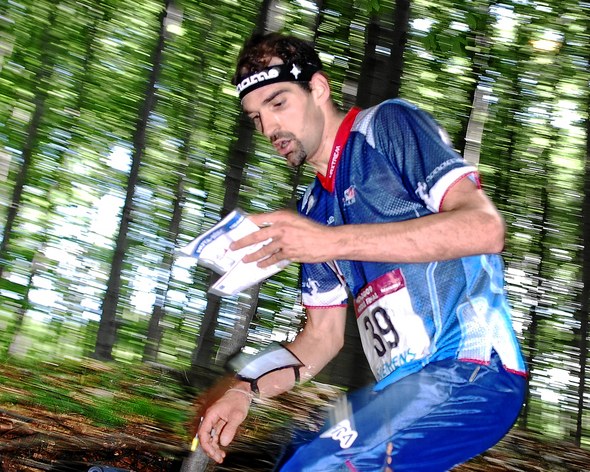
Gueorgiou: – It is still a long way to the World Championships
Posted by Jan Kocbach, 31 May 2011@5:00

thierrygueorgiou_WOC2009MiddleFinal_s
- I know that some people who don’t have a single idea of what is involved to win a WOC gold medal are already speculating with how many minutes I can win at the WOC, but I hope I have enough experience to deal with it, Thierry Gueorgiou says after his formidable win in the long distance race at Le Revard on Sunday.

- When I woke up this morning, I didn’t feel especially proud of yesterday’s performance. I still have in mind my (very) incomplete run in Prépoulain, the French o-technical specialist explains the day after his “WOC long distance simulation” (Editors remark: Selection race, May 14th were Gueorgiou lost 10 minutes at one control were a small lead at the 15th control turned into a 13th place in the finish for Gueorgiou – 9 minutes behind Olle Boström).

- I know that all the runners who beat me in the last WOC were not in the start list, and most of the others are just starting to train on these terrains. So, I don’t change a single word of what I said before the race: “it is still a long way to the World Championships”.

In WOC 2010 long distance the “King of Middle” was beaten by the two Norwegians Olav Lundanes and Anders Nordberg. In the WOC 2010 middle distance Carl Waaler Kaas and Peter Öberg were ahead on the results list. Öberg is out with injury, whereas Lundanes, Nordberg and Kaas all finished ahead of Gueorgiou on the WOC selection races on May 14th – but all three were beaten by Gueorgiou on the Norwegian and French WOC selection race over long distance on May 15th. So it is 1-1 – but still Gueorgiou’s race on Le Revard this Sunday was very impressive.

Partly new map of Le Revard

Although many of the national team runners had been training extensively on the Le Revard map ahead of the races, there was one part of the map which was new for the race on Sunday.

- I had no real idea what the new area of the terrain would look like before the race, and therefore I was quite flexible and tried to always use safe routes.

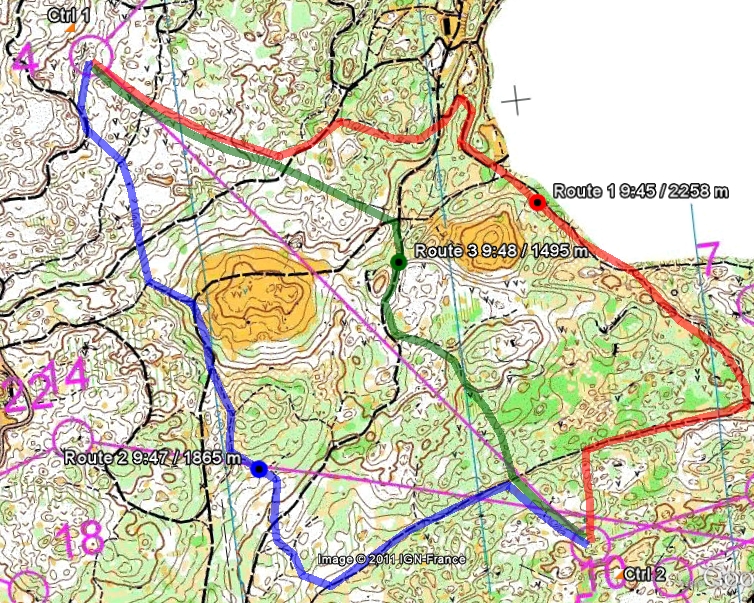
Looking at the splits, one of “Tero”’s best splits was the leg from number 4 to number 5 – winning the leg with 1:20 ahead of Mattias Millinger. In yesterday’s article at World of O this leg was discussed in some detail – and three different options were set up.

- To the 5th control, I used the green route (Editors remark: See map below). I wasn’t sure if the last part would be very fast, but I just kept the direction and tried to run aggressively in the green.

And indeed it was fast! Both Daniel Hubmann (3rd) and Philippe Adamski (4th) took variants between the blue and green line – both loosing around 2 minutes on the leg.

Even with a 9 minute victory, the perfectionist Gueorgiou did find some time losses.

- I lost some time (45 sec) in 3 different places: 10th, 14th and 17th (I had A2 version of the course). Each time, I had some difficulty to understand the map near the control circle (Editors remark: See the complete course here).

Below you see the leg from number 4 to number 5 with three different options drawn in. Also shown below is a comparison between the routes of Philippe Adamski (blue) and Klaus Schgaguler (Purple) on this leg from 3DRerun (Editors comment: Unfortunately I do not have the exact route of Gueorgiou to compare with, but he is 2(!) minutes faster than Adamski/Schgaguler who have no big time losses along their respective routes).

4-5s_s

The last(?) rant about 1:15.000

There has been a lot of discussion about the map scale for the WOC 2011 long distance. Many runners and trainers have signed a petition in order to get the map scale changed to 1:10.000. Gueorgiou has shown that he can perform well also on 1:15.000, but still was fighting for a 1:10.000 scale.

- I don’t know what the other orienteers have thought about the 1:15.000 scale, and how it has affected their performance, but I really think (once again) that it is not anymore the same sport. If I am not using my loupe, I can’t read the map while running at full speed. This is definitively not the idea I have about our sport.

Instead of changing the map scale to 1:10.000, it has been decided to keep the 1:15.000 scale for the WOC 2011 long distance – and hire two Swedish mappers to make the map more readable in 1:15.000. Not a very popular decision among most of the runners, but it doesn’t look like the decision makers listen to the runner here.

- [But] the real shame is that to make it readable with this scale, they took away some smaller details which are not especially essential to find the controls, but which give the clear picture of the terrain and the runnability which is crucial to make good route selection. Therefore, my motto during the race was “make it easy and [don't] take any risk”. For example to the 14th, I would have liked to run quite straight while using the open areas, but as some fallen trees, greens spot or stony ground are missing, you have more to loose than to win, Gueorgiou explains.

- It feels like a regression and not really enjoyable feeling finally to play it too safe. But I suppose I have missed something and the IOF controllers and all the others people in charge of this decision have understand much better the terrain and the core of our sport. That were my last words before WOC on this subject.

WOC week simulation

The French middle distance specialist has been using this week as a simulation of a full WOC week – including qualifications and finals.

- I am now continuing my simulation of the WOC week while using the new maps. I did run some sort of qualifications on Wednesday and Thursday at the French military championships. And, on Tuesday and Wednesday of this week, I will try to simulate a middle distance final and relay. Still a long way to go, but every day we are getting closer… so, it is not the time to take it easier! ;)

Le Revard loooong distance: Gueorgiou 9 minutes ahead
Posted by Jan Kocbach, 29 May 2011@22:00


[Updated with results/analysis!] Thierry Gueorgiou crushed the competitors and took a 9(!) minute win in today’s tough long distance race on the Le Revard map – the neighbour map of the World Championships. The start field was very strong – so the French runner really set the standard today.

9 minutes down from Gueorgiou in second spot was Anders Holmberg (Sweden) ; Daniel Hubmann (Switzerland) was 12 minutes behind. In the women’s class Annika Billstam (Sweden) took a 5 minute victory ahead of Helena Jansson (also Sweden).

Vincent Coupat wrote the following about Gueorgiou’s race at Twitter today: – Tough race today. My feet are destroyed : huge blisters. Thierry is impressive! Ran 4 controls with him and was unable to read my map.

Webroute

One of the interesting legs is this leg from number 4 to number 5. I have set up a webroute so you can try to figure out how you would solve the leg. Remember: Runnability is not too good – so compass course along the line would not be your best option. On the other hand, you should not go too far away either.

The article continues below the Webroute.

Without any splits/routes of runners I can’t say what is the best option – but please add a comment if you have any thoughts about it. For now I have just drawn the routes in 3DRerun, and looked at the lengths of three different options (the leftmost option in red – 2258 meter, direct right route in green is 1495 meters and the rightmost option in blue is 1865 meters – the times given are arbitrary!). The challenge for all three options is to find the correct attackpoint for the control – for the red route it should be easier to find an accurate point as you leave the path. For the green route it is most tricky. The green route is tempting, except for the tricky part into the control – and running through the green at the middle part of the leg. I’d probably choose the blue option (rightmost) based on the lengths of the different routes compared to difficulty. You do however take some extra height there.
leg4-5t

Map with course

The map is well known for most of the runners – so most competitors probably did not get any big surprises today in that regard. The Le Revard map is one of the most relevant terrains to train in ahead of WOC 2011, and Gueorgiou and many of the other competitors have surely been running a lot of trainings there.

From the Irish Team Blog: - Toni picked up an injury yesterday so went straight from the start to finish after collecting her map, David made it to 5 before going over on his ankle and at various points throughout the course there was attrition. Other teams faired in a similar way with, for example, the British team having even fewer finishers than the Irish team. A few have been particularly surprised by the rough nature of the terrain with more brashings and felled areas than expected.

Results

Thierry Gueorgiou won with an impressive 9 minutes ahead of Swedens Anders Holmberg. When studying the splits (see graphical illustration below), it seems clear that it could have been even more. If looks like Gueorgiou – starting 8 minutes later – caught Holmberg around the 10th control at a time when Holmberg was “in the pack” – and Holmberg seems to have had help from Gueorgiou to get a clear second spot. The victory might have been around 12 minutes if not (the splits might lie, but…). So – how many minutes start interval should we have at WOC 2011? In that regard it is kind of interesting to see the Norwegian Federations suggestion to have 1 minute start interval at WOC long distance in the future….

Men
1 GUEORGIOU Thierry 4201RA NOSE Fra 1:31:29
2 HOLMBERG Anders IMP004 SWE Team SWE 1:40:23
3 HUBMANN Daniel IMP001 SUI Team SUI 1:43:59
4 ADAMSKI Philippe 5907NO T.A.D. Fra 1:44:21
5 ROST Erik IMP004 SWE Team SWE 1:45:24
6 KRATOV Oleksandr IMP005 UKR Team UKR 1:45:49
7 ROLLIER Baptiste IMP001 SUI Team SUI 1:45:58
8 BOSTRÖM Olle IMP004 SWE Team SWE 1:46:11
9 MÜLLER Matthias IMP001 SUI Team SUI 1:47:57
10 NOVIKOV Valentin IMP003 RUS Team RUS 1:48:08
splits

Women
1 BILLSTAM Annika IMP004 SWE Team SWE 1:09:11
2 JANSSON Helena IMP004 SWE Team SWE 1:14:24
3 ELIASSON Lena IMP004 SWE Team SWE 1:17:43
4 ALEXANDERSSON Tove IMP004 SWE Team SWE 1:19:11
5 GUSTAFSSON Linnea IMP004 SWE Team SWE 1:19:23
6 ALM Maja IMP006 DAN Team DEN 1:20:09
7 NOVIKOVA Julia IMP003 RUS Team RUS 1:21:10
8 JURENIKOVA Eva IMP007 CZE Team CZE 1:21:33
9 CLAESSON Emma IMP004 SWE Team SWE 1:22:02
10 CHATAING Amelie 4201RA NOSE Fra 1:22:52


See also results of the Swedish runners is available here and the Swiss here (the Swiss explain their big time losses by “we still have to learn how to understand these maps”.).

WOC Selection Races Annecy, France May 28th
Posted by Jan Kocbach, 28 May 2011@22:00


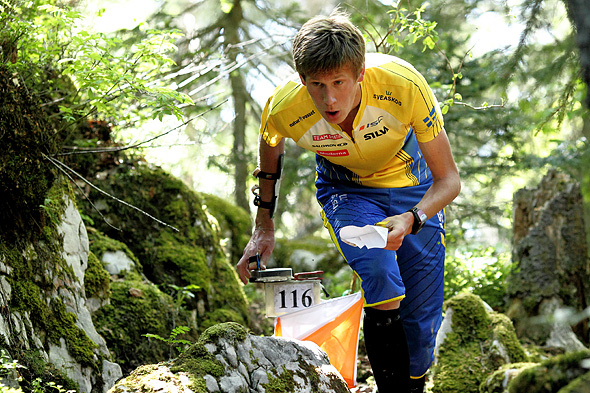
Several nations had WOC selection races in the Annecy area today on a technically challenging middle distance course today. Swedish runners took the top 3 places both in the mens and the womens class – with Olle Boström and Helena Jansson on top, respectively. In the mens class, the young Johan Runesson and Gustav Bergman followed right behind Boström in second and third spot – very impressive by the young Swedish runners. Helena Janssons victory was with more than 2 minutes ahead of Emma Claesson.

The start field was strong with national team runners from Sweden, Denmark, Czech Republic, Ukraine, Poland, Finland and France (but not Thierry Gueorgiou).

Orientering VM-test Frankrike/Schweiz Stafetträning ovanför An
Photo: Runpix.se / Peter Holgersson. Olle Boström on the way towards victory on the Swedish WOC test races.

Tomorrow the scene is set for a real challenge – a long distance race on the Le Revard map. The men run 13 kilometers with 620 meters of ascent – whereas the women have 8.6 kilometers with 390 meters ascent. Thierry Guerorgiou is reported to be on the startline for Sunday’s long distance. According to Google translate, Gueorgiou says the following about Sunday’s race: - I myself prepare as if Sunday was the final of the long distance World Championships. My commitment is total, while keeping in mind that whatever happens, the road is still long after this race.

Map and courses

Leg 2-3
Leg 2-3 in the mens course. Split times are approximate.

The runners were met by tricky middle distance courses. Most of the courses was about accurate fine orienteering, but there were also a few longer courses with route choice options. The WOC 2011 terrain – and also the terrain of these test races – has quite bad runnability, and therefore you can often run quite long detours if you can keep higher speed and have easier orienteering that way. Above you see leg 2-3 in the mens course were it looks like it is advantageous to run around rather than run direct (although you’d need more data to be sure).

Results

Men – Top 10
1 368 BOSTROM Olle 90 SWEDEN TEAM H21 28:09
2 383 RUNESSON Johan 90 SWEDEN TEAM H21 29:16
3 367 BERGMAN Gustav 90 SWEDEN TEAM H21 29:39
4 80 DLABAJA Tomas 83 CZECH TEAM H21 30:10
5 371 JOHANSSON Fredrik 86 SWEDEN TEAM H21 30:17
6 17 USHKVAROK Pavlo 83 UKRAINIAN TEAM H21 30:34
6 609 ADAMSKI Philippe 85 5907NO T.A.D. H21 30:34
8 373 KARLSSON Mattias 91 SWEDEN TEAM H21 30:44
9 380 MILLINGER Mattias 84 SWEDEN TEAM H21 30:54
10 100 MYHREN Jonn Are 79 IFK Lidingo SOK H21 31:00

Women – Top 10
1 397 JANSSON Helena 85 SWEDEN TEAM D21 26:53
2 390 CLAESSON Emma 77 SWEDEN TEAM D21 29:00
3 389 BILLSTAM Annika 76 SWEDEN TEAM D21 30:27
4 45 VERCELLOTTI Lea 89 2517FC OTB D21 31:14
5 590 ALM Maja 88 DANISH TEAM D21 31:25
6 395 GUSTAFSSON Linnea 86 SWEDEN TEAM D21 31:35
7 86 BROZKOVA Dana 81 CZECH TEAM D21 31:41
8 435 NOVIKOVA Julia 80 RUSSIA TEAM D21 31:48
9 404 STRAND Lina 88 SWEDEN TEAM D21 31:59
10 386 ALEXANDERSSON Tove 92 SWEDEN TEAM D21 32:11

New map for model event

For the runners training for WOC 2011, it may be interesting to note that a new map adjacent to the WOC area has been made official for the model event (see above). This looks like another very technical terrain – somewhere between the Montagne de Bange and Le Revard in difficulty.

Orientering VM-test Frankrike/Schweiz Stafetträning ovanför An
Photo: Runpix.se / Peter Holgersson. Helena Jansson was the best with big margin in the Swedish WOC test races.

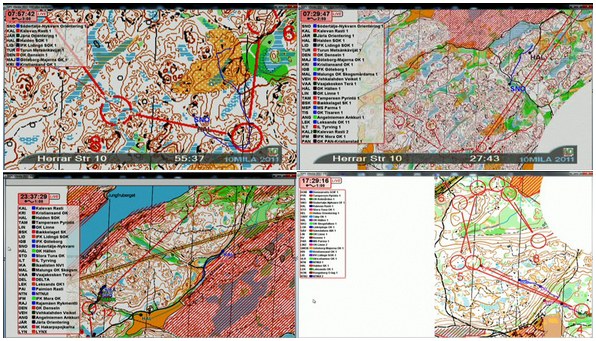
10Mila GPS Tracking finally live! See analysis here!

Posted by Jan Kocbach, 02 May 2011@22:12


Many interesting long legs in this years 10Mila means a lot of interesting analysis using the GPS data! Now the GPS Tracking is online – get ready for some fun understanding the best options. Why not use the opportunity to learn something as well – draw your suggested best route on each leg before reading the analysis. Adding a comment makes it easier for other to understand why you choose a certain route.

The 10Mila relay had very nice courses this year – a “Jukola-like” gaffling system – i.e. more gaffling than we’ve seen the last years – along with many long legs made it really interesting for the runners.

Disclaimer for all my analysis/comments: I have not been in the forest – analysis and comments is done based on GPS data only – thus conclusions might not always be 100% correct. But PLEASE correct me in a comment if I’m wrong – that would make everybody happy, especially me.

Link to GPS tracking

Here you find links to the GPS tracking (will be updated with more legs):

Analysis – 6th leg, control 10-11

We’ll start with a webroute to get your thoughts going – below is analysis of both this leg and other legs. This is control number 10-11 on the 6th leg of the men’s relay – a night leg. The leg is as usually first provided without routes – you may take a look at it and think about how you would attack this leg (if the image is too small, you may click on it to get it larger).

Next you can draw your own route using the ‘Webroute’ below. Think through how you would attack this leg, and draw the route you would have made. Some comments about why you would choose a certain route are always nice for the other readers.

Now you can take a look at a graphical analysis of the leg based on the GPS-data of some of the fastest runners between these controls (click on an image to see a larger version of it). Note that times are off the GPS, so there might be some inaccuracies at the start/end of each route/track.

The leftmost option surely looks to be the best option on this leg on nightorienteering

Analysis: There are basically three options for this leg: (1) A direct option passing along the edge of the forbidden area – see MS Parma’s route, (2) A left variant with 80% path, open field and road – mostly large paths – see OK Denseln’s route. (3) A right variant with more than 90% paths – significant amounts of that being small paths. Of the teams with GPS tracking, most teams have taken variants of the direct option with some curves here and there to use paths. Some have taken the left option, but none have taken the rightmost option (note however that the two first drawing their webroute choose the rightmost option).

Looking at the illustrations below, you can see that the fastest time is run by OK Denseln running the left variant even if it is more than 10% longer than the direct route. The reason for this is the very high speed you can run in on the road/track/open field, which is very nicely illustrated on the pace map. Also, the direct route is not really direct – you actually do a lot of curves when trying to run it optimally, giving a running distance of around 2160 meters on the 1980 meter long leg (the leftmost is around 2390 meters). Add to that that the leftmost route is much more secure than the direct route (many obviously could not keep their direction), the leftmost option surely looks to be the best option on this leg on nightorienteering. The rightmost option could look tempting due to the amount of running on paths, but as (1) small paths are usually slower and (2) it is longer than the rightmost route, I’d think the leftmost route is the choice to take here.

Figure: Direct comparison between routes. Points along the routes at which the runners have used the same time are connected – thus you can easily see where one route is faster/slower than another.

Figure: Pace map – each point along the routes is colored according to the minimum pace at that point. Thus is is possible to identify where the runnability is good/bad.

Figure: Routes are colored according to total time on the leg – green is fast, red is slow.

Analysis – 3rd leg, control 8-9

This is also night orienteering – this time control 8-9 on leg number 3. Again you get the possibility to think through the route and drawing your route before reading the analysis.

Draw your own route using the ‘Webroute’ below.

Analysis: There are four different options for this leg. (1) A direct variant going mostly in the terrain except for the last part of the leg (light blue below), (2) a rightmost variant following small paths at the first part of the leg and then meeting the direct route for the last part of the leg (dark blue), (3) a long far left variant on the road (red) and (4) another left/direct alternative (pink).

When looking at the split times, I was at first surprised that the direct route was only a few seconds slower than the rightmost route which is the fastest

Looking at the split times, the right variant is the fastest followed by the direct route (see the first illustration below where the fastest runner along each of the alternatives is shown). The rightmost is the fastest route due to (1) large parts of the route is on paths while (2) the route is not significantly longer than the other alternatives. When looking at the split times, I was at first surprised that the direct route was only a few seconds slower than the rightmost route which is the fastest.

The reason for this is found when you study the first part of the leg in some detail. In the second illustration below, a “dot-map” is shown – connecting times at which each runner has used the same time on the route. Here you can see that the runner taking the rightmost option is on the road nearly 30 seconds after the runner taking the direct option. Thus in the end there is only a slight advantage of some seconds by taking the rightmost option. On the other hand, the rightmost choice is in my opinion a better and more “night orienteering route choice”, as there is significantly more path running (and not even on small paths). Talking about night orienteering route choices, the far left option on the road and track is a real night orienteering route choice. However, it is far too long in this specific case. The runnability is not that bad for the runner taking the rightmost option on the path.

Looking at the colored routes of all runners running with a GPS in the third figure below, you can clearly see that the right on the path seems to be the optimal. This is the route for which most runners have a good time. Looking further down at the fourth illustration, you see a pace map where the high running speed on the path to the right can be clearly identified.

Figure: Comparison of selected routes

Figure: Direct comparison between routes. Points along the routes at which the runners have used the same time are connected – thus you can easily see where one route is faster/slower than another.

Figure: Routes are colored according to total time on the leg – green is fast, red is slow.

Figure: Pace map – each point along the routes is colored according to the minimum pace at that point. Thus is is possible to identify where the runnability is good/bad.

Analysis – 3rd leg, control Start-1 (gaffling W)

This is yet another control from leg number 3 – that means again night orienteering. This time we look at the first control on leg number 3. The most interesting of the gaffles for this leg is the westmost. Again you get the possibility to think through the route and drawing your route before reading the analysis.

Her you can draw your suggested route:

Analysis: Note that some of the GPS tracks shown below actually might belong to runners having one of the other gaffles but just passing this control – still the time should be relevant with respect to which time it takes to reach the control along each route. There were several alternatives for this route as you can see on the illustration below. The fastest route is the route of Kalevan Rasti (green in the first illustration) going all the way to the left.

The optimal route is actually calculated to be a direct route – passing the other gaffling control on the middle of the leg.

However, looking in more detail at the GPS data using a “same-time-illustration” (the second illustration below) where you see how long it would take a runner to reach any “reachable” point on the different routes, you can make two interesting observations,

  1. The optimal route is actually calculated to be a direct route – passing the other gaffling control on the middle of the leg. None of the runners taking this option and running with GPS seem to have managed to take the optimum route and find the control.
  2. Compared to Kalevan Rasti’s route, it should actually be just as fast to follow the route of Vaajakosken T. (light green) in the first part of the leg, and then following the route of Kalevan Rasti for the rest of the route.

However, both these observations are theory only – Kalevan Rasti took the fastest choice here. Still, it is interesting to note.

The final figure below is a pace plot show the maximum pace on different parts of the routes. It also shows that there was a lot of mistakes around the first control.

Figure: Routes are colored according to total time on the leg – green is fast, red is slow.

Figure: “Same-time-illustration” and calculation of optimum route.

Figure: Pace map – each point along the routes is colored according to the minimum pace at that point. Thus is is possible to identify where the runnability is good/bad.

Analysis – Womens course – 3rd leg, control 3-4

Finally a leg from the women’s race – leg number 3 (ungaffled) day orienteering. Again you get the possibility to think through the route and drawing your route before reading the analysis.

Her you can draw your suggested route:

Analysis: This was a short leg on an ungaffled course, and it was very surprising to see this much spreading on the route choices (note however that the GPS data was not very good at this leg, so don’t trust the GPS data fully). For me it was surprising to see that many runners choose different variants to the right (see first illustration below) – as it is significantly longer, and there can not be much to gain by going right when you do not follow the path for significant parts of the route.

For me it was surprising to see that many runners choose different variants to the right

This can also be seen from the split times in the illustration. The ones choosing a left variant are clearly faster. There are some relatively fast splits on the variants to the right – and some slow to the left, but the trend is very clear.

Comparing the fastest of the left runners with the fastest of the right (second illustration below), you can see that the runner on the left can run very fast all the way to the edge of the forbidden area, and then has a lot shorter to the control than the runner on the right. 200 meter extra on a 800 meter leg can not be beneficial as long as the runnability is not significantly better on the longer route – here the runnability is approximately equal.

Figure: Routes are colored according to total time on the leg – green is fast, red is slow.

Figure: Direct comparison between routes. Points along the routes at which the runners have used the same time are connected – thus you can easily see where one route is faster/slower than another.

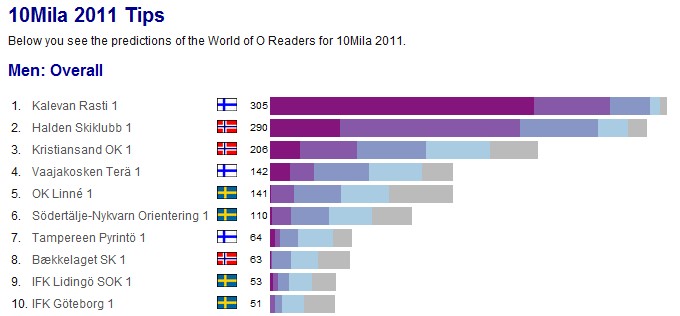
10Mila Tips 2011: The winner is…

Posted by Jan Kocbach, 01 May 2011@10:00

predictions_results
More than 300 people set up their tips in the 10Mila Tips 2011.  According to the preliminary unofficial results, Lekuu won the 10Mila 2011 Tips with 937.5 points – only 5.5 points ahead of Severin Howald. Congratulations – this means the prize of 2 transferable starts for the complete OOCup 2011 is going his way as long as the official results are unchanged from the preliminary results.

The key to Leeku’s (unofficial as of now) victory was tipping the correct overall winner and second place in both men’s and women’s classes – this giving 520 of the 937.5 points. Below you see the unofficial results – please add a comment if you spot any errors.

1. Lekuu: 937.5 points
Men: Overall 381 points Kalevan Rasti 1 (1, 150 points) Halden Skiklubb 1 (2, 110 points) Södertälje-Nykvarn Orientering 1 (3, 70 points) Kristiansand OK 1 (7, 36 points) Bækkelaget SK 1 (16, 15 points)
Men: After 1st leg 93 points OK Denseln 1 (3, 30 points) Vaajakosken Terä 1 (10, 13 points) Kalevan Rasti 1 (1, 50 points)
Men: After 4th leg 36 points Tampereen Pyrintö 1 (19, 6 points) Kristiansand OK 1 (11, 12 points) Halden Skiklubb 1 (7, 18 points)
Women: Overall 370 points Tampereen Pyrintö 1 (1, 150 points) IFK Lidingö SOK 1 (2, 110 points) Leksands OK 1 (8, 32 points) Domnarvets GoIF 1 (3, 60 points) NTNUI 1 (14, 18 points)
Women: After 1st leg 57.5 points Ulricehamns OK 1 (57, 0 points) Tampereen Pyrintö 1 (5, 22.5 points) Domnarvets GoIF 1 (3, 35 points)
2. Severin Howald: 932 points
Men: Overall 364 points Kalevan Rasti 1 (1, 150 points) Halden Skiklubb 1 (2, 110 points) Vehkalahden Veikot 1 (10, 26 points) Vaajakosken Terä 1 (14, 18 points) Södertälje-Nykvarn Orientering 1 (3, 60 points)
Men: After 1st leg 75 points Kalevan Rasti 1 (1, 75 points) Rajamäen Rykmentti 1 (40, 0 points) MS Parma 1 (??, 0 points)
Men: After 4th leg 38.5 points Tampereen Pyrintö 1 (19, 6 points) Järla Orientering 1 (4, 25 points) Vaajakosken Terä 1 (16, 7.5 points)
Women: Overall 412 points Tampereen Pyrintö 1 (1, 150 points) IFK Lidingö SOK 1 (2, 110 points) Domnarvets GoIF 1 (3, 70 points) Stora Tuna OK 1 (4, 50 points) Leksands OK 1 (8, 32 points)
Women: After 1st leg 42.5 points OK Hällen 1 (12, 11 points) Tampereen Pyrintö 1 (5, 22.5 points) OK Kolmården 1 (14, 9 points)
3. Fredrik E: 886 points
Men: Overall 382 points Kalevan Rasti 1 (1, 150 points) Halden Skiklubb 1 (2, 110 points) Södertälje-Nykvarn Orientering 1 (3, 70 points) Kristiansand OK 1 (7, 36 points) OK Linné 1 (15, 16 points)
Men: After 1st leg 90 points Ikaalisten NV 1 (??, 0 points) Kalevan Rasti 1 (1, 50 points) Södertälje-Nykvarn Orientering 1 (2, 40 points)
Men: After 4th leg 31.5 points OK Hällen 1 (6, 20 points) Raumar O-lag 1 (23, 4 points) Vaajakosken Terä 1 (16, 7.5 points)
Women: Overall 352 points Domnarvets GoIF 1 (3, 60 points) IFK Lidingö SOK 1 (2, 110 points) Stora Tuna OK 1 (4, 50 points) Tampereen Pyrintö 1 (1, 100 points) Leksands OK 1 (8, 32 points)
Women: After 1st leg 30.5 points OK Kolmården 1 (14, 9 points) LYNX 1 (24, 3.5 points) OK Linné 1 (7, 18 points)
4. Juuso Kujanpää: 879.5 points
Men: Overall 384 points Kalevan Rasti 1 (1, 150 points) Halden Skiklubb 1 (2, 110 points) Södertälje-Nykvarn Orientering 1 (3, 70 points) Kristiansand OK 1 (7, 36 points) Vaajakosken Terä 1 (14, 18 points)
Men: After 1st leg 103 points Vaajakosken Terä 1 (10, 13 points) Kalevan Rasti 1 (1, 50 points) Södertälje-Nykvarn Orientering 1 (2, 40 points)
Men: After 4th leg 50.5 points Järla Orientering 1 (4, 25 points) Vaajakosken Terä 1 (16, 7.5 points) Halden Skiklubb 1 (7, 18 points)
Women: Overall 330 points Leksands OK 1 (8, 32 points) IFK Lidingö SOK 1 (2, 110 points) Domnarvets GoIF 1 (3, 70 points) NTNUI 1 (14, 18 points) Tampereen Pyrintö 1 (1, 100 points)
Women: After 1st leg 12 points NTNUI 1 (17, 7 points) Stora Tuna OK 1 (21, 5 points) Leksands OK 1 (58, 0 points)
5. Pyry Paloposki: 872 points
Men: Overall 354 points Kalevan Rasti 1 (1, 150 points) Vaajakosken Terä 1 (14, 18 points) Södertälje-Nykvarn Orientering 1 (3, 70 points) Kristiansand OK 1 (7, 36 points) Halden Skiklubb 1 (2, 80 points)
Men: After 1st leg 108 points Kristiansand OK 1 (7, 18 points) Kalevan Rasti 1 (1, 50 points) Södertälje-Nykvarn Orientering 1 (2, 40 points)
Men: After 4th leg 47.5 points Kalevan Rasti 1 (3, 30 points) Södertälje-Nykvarn Orientering 1 (13, 10 points) Vaajakosken Terä 1 (16, 7.5 points)
Women: Overall 340 points Tampereen Pyrintö 1 (1, 150 points) IFK Lidingö SOK 1 (2, 110 points) Halden Skiklubb 1 (13, 20 points) Domnarvets GoIF 1 (3, 60 points) Paimion Rasti 1 (??, 0 points)
Women: After 1st leg 22.5 points Tampereen Pyrintö 1 (5, 22.5 points) Ulricehamns OK 1 (57, 0 points) Halden Skiklubb 1 (129, 0 points)
6. Bruno Nazário: 868 points
Men: Overall 334 points Kalevan Rasti 1 (1, 150 points) Halden Skiklubb 1 (2, 110 points) Kristiansand OK 1 (7, 36 points) Vaajakosken Terä 1 (14, 18 points) IFK Göteborg 1 (13, 20 points)
Men: After 1st leg 130 points Kalevan Rasti 1 (1, 75 points) Södertälje-Nykvarn Orientering 1 (2, 55 points) Malungs OK Skogsmårdarna 1 (41, 0 points)
Men: After 4th leg 60 points Kalevan Rasti 1 (3, 30 points) Halden Skiklubb 1 (7, 18 points) Kristiansand OK 1 (11, 12 points)
Women: Overall 326 points Domnarvets GoIF 1 (3, 60 points) IFK Lidingö SOK 1 (2, 110 points) Tampereen Pyrintö 1 (1, 100 points) Halden Skiklubb 1 (13, 20 points) OK Hällen 1 (7, 36 points)
Women: After 1st leg 18 points IFK Lidingö SOK 1 (79, 0 points) Halden Skiklubb 1 (129, 0 points) OK Linné 1 (7, 18 points)
7. Erik Martinsson: 850.5 points
Men: Overall 344 points Kalevan Rasti 1 (1, 150 points) Kristiansand OK 1 (7, 36 points) Halden Skiklubb 1 (2, 80 points) Södertälje-Nykvarn Orientering 1 (3, 60 points) Vaajakosken Terä 1 (14, 18 points)
Men: After 1st leg 80 points Kalevan Rasti 1 (1, 75 points) DELTA 1 (21, 5 points) Vehkalahden Veikot 1 (32, 0 points)
Men: After 4th leg 73 points Järla Orientering 1 (4, 25 points) OK Denseln 1 (10, 13 points) Kalevan Rasti 1 (3, 35 points)
Women: Overall 270 points Domnarvets GoIF 1 (3, 60 points) IFK Lidingö SOK 1 (2, 110 points) NTNUI 1 (14, 18 points) Stora Tuna OK 1 (4, 50 points) Leksands OK 1 (8, 32 points)
Women: After 1st leg 83.5 points Domnarvets GoIF 1 (3, 30 points) LYNX 1 (24, 3.5 points) Paimion Rasti 1 (1, 50 points)
8. Tim: 840.5 points
Men: Overall 325 points Kalevan Rasti 1 (1, 150 points) Halden Skiklubb 1 (2, 110 points) Kristiansand OK 1 (7, 36 points) DELTA 1 (22, 9 points) IFK Göteborg 1 (13, 20 points)
Men: After 1st leg 63 points Vaajakosken Terä 1 (10, 13 points) Kalevan Rasti 1 (1, 50 points) Turun Metsänkävijät 1 (??, 0 points)
Men: After 4th leg 25.5 points Vaajakosken Terä 1 (16, 7.5 points) DELTA 1 (??, 0 points) Halden Skiklubb 1 (7, 18 points)
Women: Overall 352 points Domnarvets GoIF 1 (3, 60 points) IFK Lidingö SOK 1 (2, 110 points) Tampereen Pyrintö 1 (1, 100 points) Leksands OK 1 (8, 32 points) Stora Tuna OK 1 (4, 50 points)
Women: After 1st leg 75 points Paimion Rasti 1 (1, 75 points) IFK Lidingö SOK 1 (79, 0 points) Rasti-Lukko 1 (105, 0 points)
9. Rasmus Oscar: 838 points
Men: Overall 344 points Kalevan Rasti 1 (1, 150 points) Södertälje-Nykvarn Orientering 1 (3, 60 points) Kristiansand OK 1 (7, 36 points) Vaajakosken Terä 1 (14, 18 points) Halden Skiklubb 1 (2, 80 points)
Men: After 1st leg 75 points Kalevan Rasti 1 (1, 75 points) OK Orion 1 (??, 0 points) Tampereen Pyrintö 1 (??, 0 points)
Men: After 4th leg 61 points OK Linné 1 (29, 1 points) Järla Orientering 1 (4, 25 points) Kalevan Rasti 1 (3, 35 points)
Women: Overall 322 points Domnarvets GoIF 1 (3, 60 points) IFK Lidingö SOK 1 (2, 110 points) Tampereen Pyrintö 1 (1, 100 points) Leksands OK 1 (8, 32 points) Halden Skiklubb 1 (13, 20 points)
Women: After 1st leg 36 points Domnarvets GoIF 1 (3, 30 points) Halden Skiklubb 1 (129, 0 points) Hellas Orientering 1 (19, 6 points)
10. Jere Pajunen: 832 points
Men: Overall 350 points Kalevan Rasti 1 (1, 150 points) Vaajakosken Terä 1 (14, 18 points) Södertälje-Nykvarn Orientering 1 (3, 70 points) Halden Skiklubb 1 (2, 80 points) IFK Lidingö SOK 1 (8, 32 points)
Men: After 1st leg 61 points IFK Lidingö SOK 1 (12, 11 points) Kalevan Rasti 1 (1, 50 points) Rehns BK 1 (??, 0 points)
Men: After 4th leg 43.5 points Kalevan Rasti 1 (3, 30 points) Tampereen Pyrintö 1 (19, 6 points) Vaajakosken Terä 1 (16, 7.5 points)
Women: Overall 318 points Domnarvets GoIF 1 (3, 60 points) IFK Lidingö SOK 1 (2, 110 points) Ulricehamns OK 1 (10, 26 points) Tampereen Pyrintö 1 (1, 100 points) Kalevan Rasti 1 (12, 22 points)
Women: After 1st leg 59.5 points Domnarvets GoIF 1 (3, 30 points) NTNUI 1 (17, 7 points) Tampereen Pyrintö 1 (5, 22.5 points)

Prizes:

  • 1st prize: 2 transferable starts for the complete OOCup 2011

The winner will be contacted with details about the prize when the results are final and official.

About 10Mila Tips 2011 Sponsor: OOCup

OOCup is a popular Slovenian event which is famous for its interesting karst orienteering and great nature. OOCup 2011 is organized from July 22th until July 26th. See maps from some of the terrains of OOCup 2011 in omaps.worldofo.com for example from Xtremor 2009 here, here or here.

Replay the 10Mila excitement here!

Posted by Jan Kocbach, 01 May 2011@9:00

10mila2011
- I said to my team mates ahead of the race that only 6 teams have won 10Mila 2 years in a row, and I wanted to be one of them, Thierry Gueorgiou commented after taking Kalevan Rasti to victory in 10Mila just as last year. His team mates made it easy for Gueoriou this year.- I thought I had just a perfect starting position for the last leg. It is very comfortable to have such a big lead, because you can choose which speed you want to use and where.

Exactly like last year, Fabian Hertner set the table for Thierry Gueorgiou on the 9th leg, running away from the other teams on shear running speed. Gueorgiou continued with great speed and excellent orienteering.

kal3
A recap of the relay (scroll down to the bottom for the LiveBlog):

Below you can replay all the excitement in both the men and women relay in the LiveBlog – scroll all the way to the bottom to get the finish. Thanks for all 4400 readers on the LiveBlog during the 10Mila day & night, the moderators posting 550 comments and the viewers posting more than 1200 comments! Welcome back at the Jukola LiveBlog in June!