 World of O News
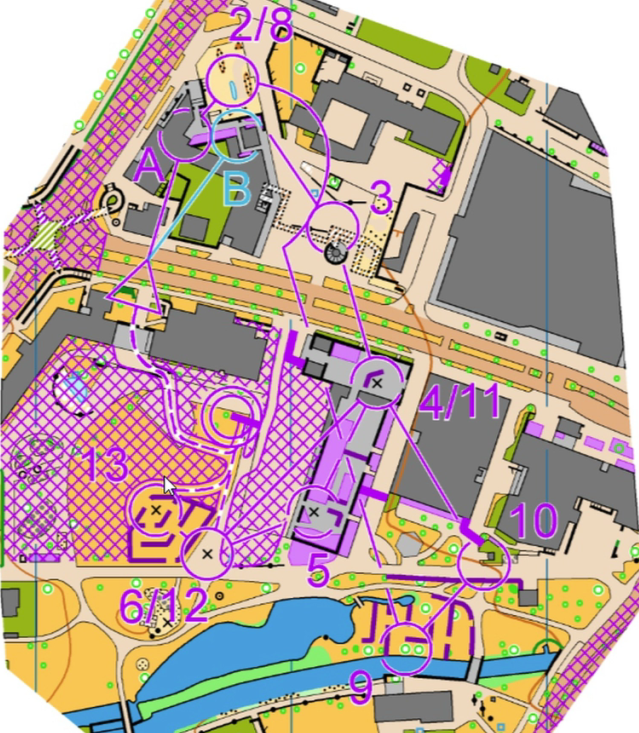
The “Orienteering Course of the Year 2025″ is a set of courses from the newest discipline in orienteering – the Knock-Out Sprint discipline, from the World Cup Final in Uster, Switzerland. And as you can read in the interview with the course setter below, a lot of work and passion was put into these courses!
Middle distance courses have been voted to the top of “The Orienteering Course of the Year” in both 2024 and 2023 – this year it was time for a sprint course to shine again, just like in 2022! The introduction of the Knock-Out Sprint format in the World Cup back in 2018 was quite controversial. There are still mixed feeling among orienteers concerning this discipline, but when the course setters succeed, and the terrain fits the discipline, it is possible to make excellent competitions and intriguing head-to-head orienteering. This was definitely shown in the three rounds of the Knock-Out Sprint at the World Cup Final in Uster!
In the very interesting interview with the course setter Silvan Ullmann below, you can read about all the work going into the planning of the courses, and also about Ullmann’s thoughs about the development and future of the discipline. Ullman has really given a lot of thought into putting real orienteering into the Knock-Out Sprint discipline – making an effort to “restore the physical-technical balance” by designing technically challenging legs that promote individual navigation and decision-making.
World Cup Final 2025 Knock-Out Sprint

» See map in omaps.worldofo.com
Long and Middle course of the year
The “Long distance course of the Year 2025″ was the World Cup Long distance race in Idre, in second spot overall, another of the big highlights on this year’s World Cup calendar. You can take a look at one of the most interesting legs in the course in Day 24 of Route to Christmas, and a more detailed look at all of the course in the World Cup Idre analysis article.
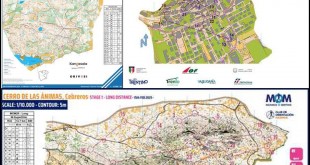
The “Middle distance Course of the Year 2025″ was actually all the way down in 11th place – the VIII Trofeo Extremadura Middle distance, with some very interesting orienteering in tricky, stony terrain. You can take a look at the course here.
The results in “Course of the Year 2024″ are provided below the interview with the course setter – in this edition we had 6 different countries in the Top 6! Before heading over to the interview with the course setter– a big thanks to all the sponsors of “Course of the Year” – without you this would not have been possible.
Dear readers: Please head down to the bottom of the article and take a look at our great sponsors. There you will also find the winners of the sponsor prizes – the “Lucky voters”.

Interview with course setter of Course of the year 2025 – Silvan Ullmann
Q: Congratulations on winning the “Course of the Year 2025″ award! This is the first time a Knock-Out Sprint has won this prestigious award. What does this recognition mean to you personally?
Thank you very much, it is a great honour to be among the recipients of this prestigious title. I’ve followed your Route to Christmas and Course of the Year series for many years, and I never imagined I would one day be featured so prominently myself. I’m very happy that with World of O, there is a platform that showcases the many great orienteering courses from around the world and recognises the people behind them.
Q: The Knock-Out Sprint format has quite an interesting history — development began in 2015 when the IOF split WOC into Sprint/Urban and Forest formats, with the first official World Cup race in Prague in 2018. Its first WOC appearance did not come until 2022. As someone who has now created an award-winning course, how do you see the format’s evolution over these years? And how have you experienced this as a runner?
I’ve been following KO Sprint races almost since their beginnings. I remember taking part several times in a city race series around Zürich that experimented with forked mass-start finals already in 2012, and gaining some of my first mapping and course-setting experiences from a training sprint series with (unfair) forked mass starts in 2015 together with friends from my home club. Ever since then, I’ve been fascinated by head-to-head orienteering battles at very high speeds.
I’ve since followed the development of this discipline very closely and have taken part in many trainings and races. In the early days, the courses were almost always forked in some way. Later, especially in the build-up to WOC in Denmark, organisers also began experimenting with unforked courses.
Whereas the pace used to be very high right from the start, many recent races have seen more “sit-and-kick” tactics, similar to what we know from athletics, cross-country skiing, or cycling.
Since then, forked KO-S courses have become quite rare at the international level and athlete strategies have gradually shifted. Whereas the pace used to be very high right from the start, many recent races have seen more “sit-and-kick” tactics, similar to what we know from athletics, cross-country skiing, or cycling. This has shifted KO-S toward an imbalance, favouring physical abilities over technical skills, which, in my opinion, should remain at the core of our sport. As a result, there is barely any incentive to do active navigation, as others can simply follow.
Q: What was your vision when planning the KO Sprint courses in Uster?
In an effort to “restore” the physical-technical balance, I set four personal guidelines early in the course-setting process:
- Design technically challenging legs that promote individual navigation and decision-making
- Split up the runners early to make the race faster and more dynamic
- Ensure fairness; and
- Consider athletes’ preparation opportunities while including unexpected elements to surprise them
Aspects (1) and (2) often go hand in hand, since slow running speeds greatly reduce the technical challenges provided by the course setter. From studying race developments in recent years, I found that following these guidelines is not achievable with only straight courses, but requires well-balanced forkings.
I found that following these guidelines is not achievable with only straight courses, but requires well-balanced forkings.
Q: What were the main constraints you faced going into the project?
As usual for KO Sprint courses, the ones in Uster came with demanding arena requirements: all three had to finish there, while the semi final and final also needed to start in the arena, ideally with arena passages. So, the course planning began by looking for technically interesting areas that could be reached from the arena within the relatively short course lengths.
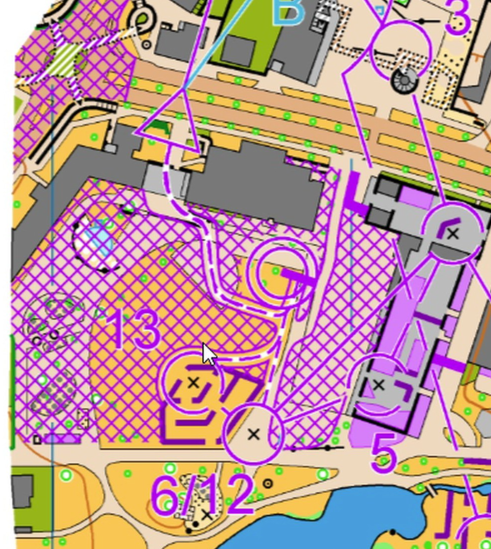
Q: Did you have a course setter team with you on this job? And roughly how many hours did you spend planning these courses?
For the World Cup finals in Uster, our course-setting team consisted of only three people, with one person responsible for each race. As a result, the KO-S concepts were developed entirely by me. I did, however, receive multiple rounds of feedback and small adjustment suggestions from the event director, the event controllers, and the IOF event adviser, which allowed me to refine the courses step by step.
In total, I designed five quarter final courses, three semi final courses, and three final courses. The final versions emerged through an iterative process, as earlier drafts were discarded due to unbalanced forkings or areas that couldn’t be mapped fairly (or had earlier mapping inaccuracies). I never counted the hours, but the work certainly added up to several hundred.
Q: Can you walk us through your approach to designing the three courses, the main considerations and challenges you faced, and how effective the courses turned out in practice?
Quarter Final
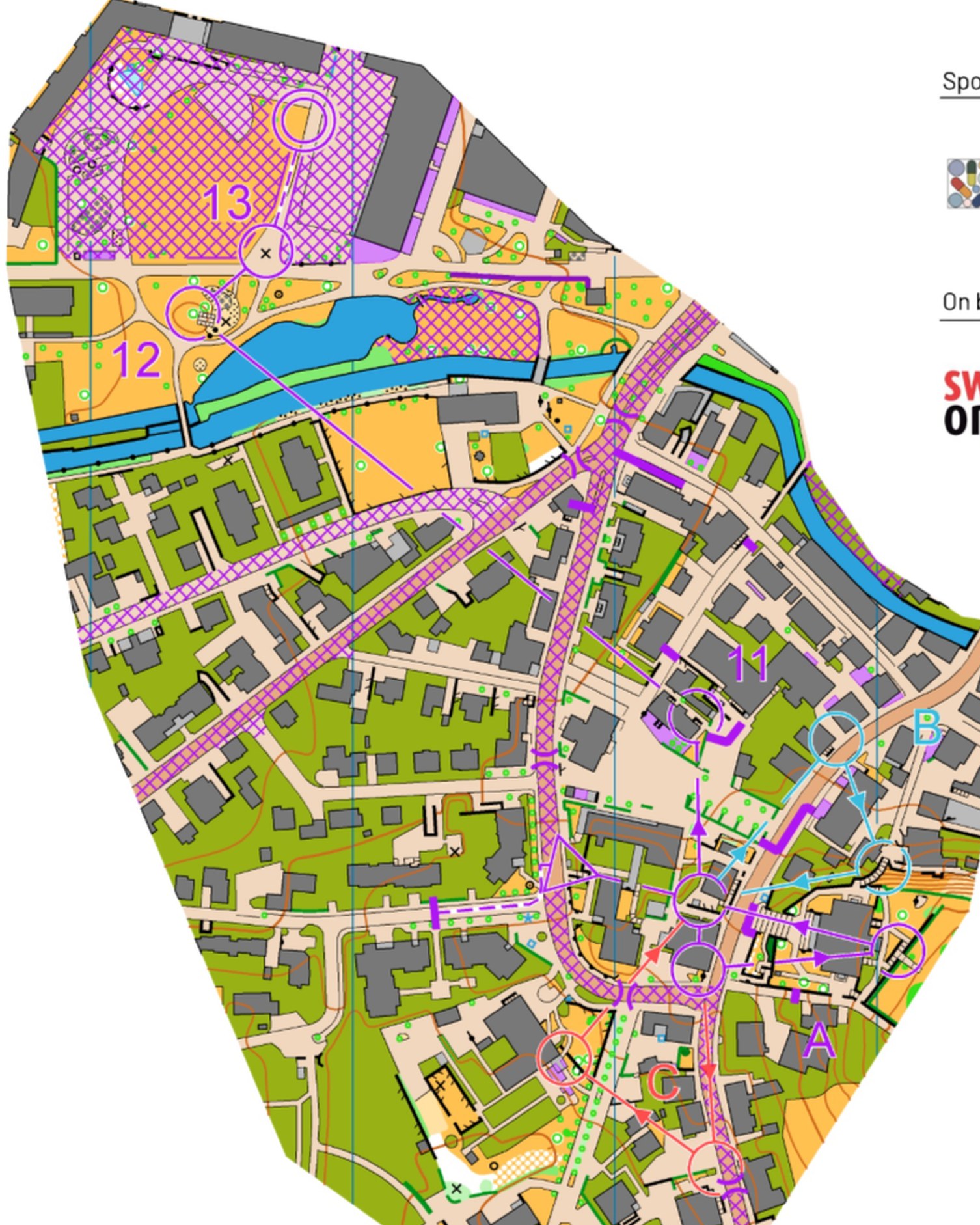
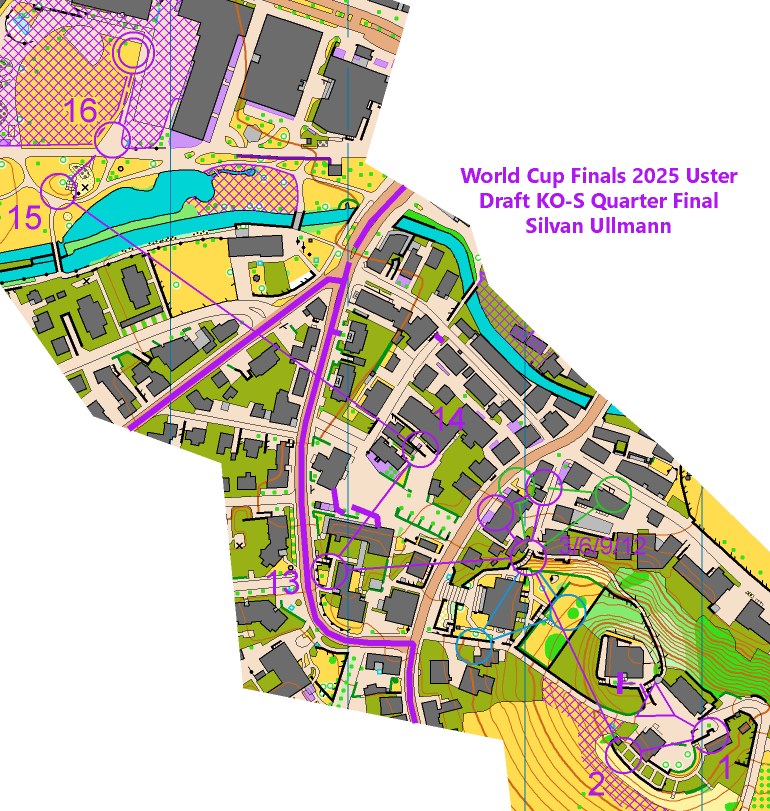
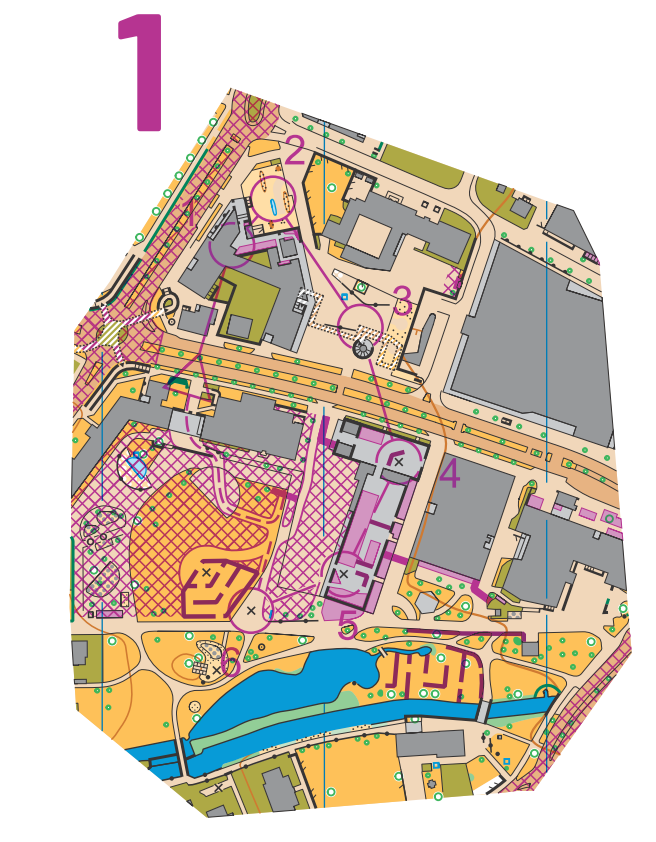
The option of placing the start a bit farther from the arena opened up access to a more technically demanding area for the quarter final. The part of town below the castle turned out to be an ideal choice: it features lots of small passages that mostly hadn’t been mapped before (see the quarter final overlaid on the old map below), along with some physical challenges thanks to hilly sections and stairways.
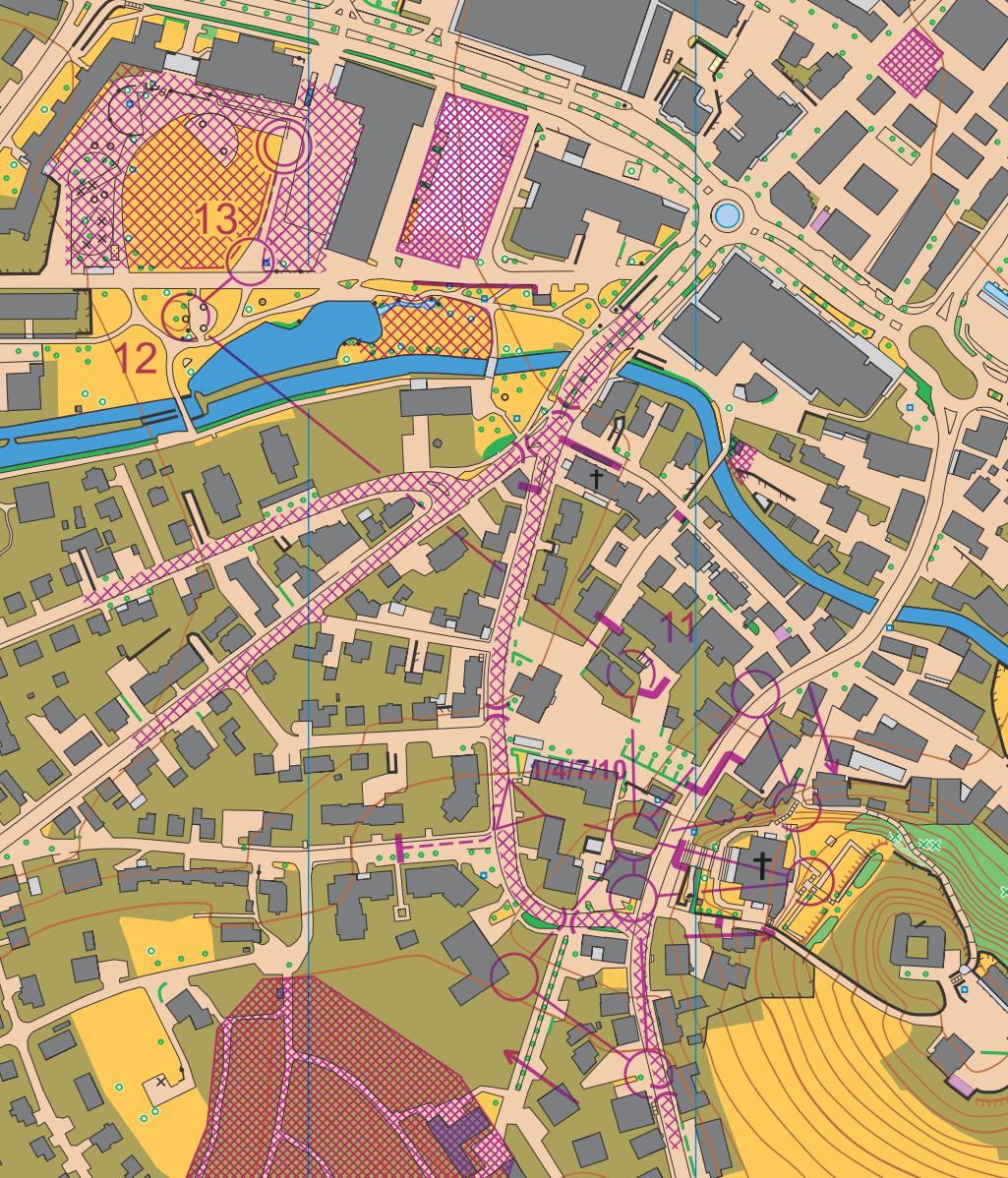
I chose the forking system of short butterfly loops to test the athletes’ individual technical skills early in the race.
The course was split into four map sections in an effort to hide the used forking system for as long as possible.
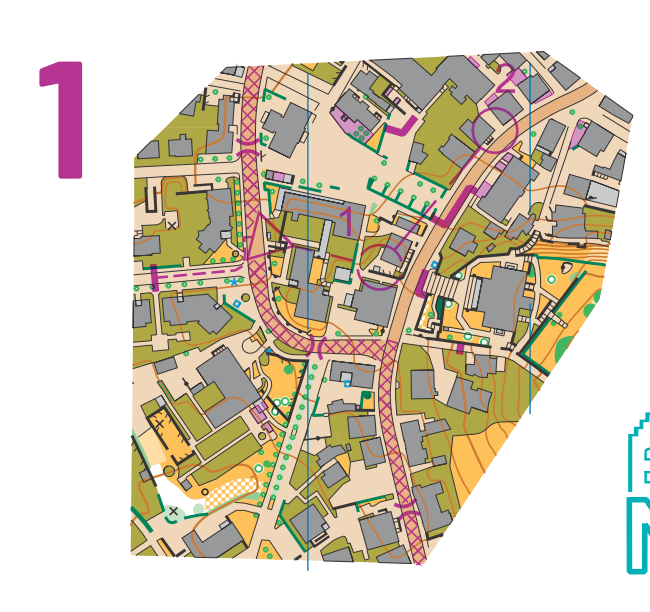
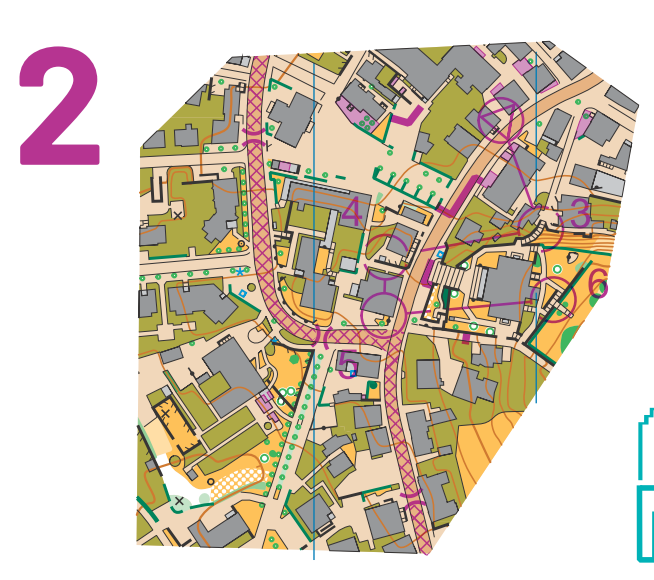
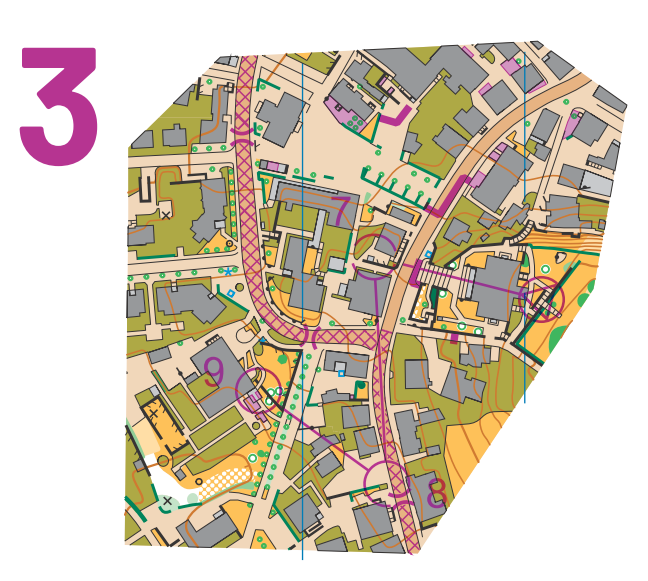
To avoid overusing the terrain around the arena, I added a long “transport leg” to the arena with many (sub-)options. This concept was already visible in the early drafts.
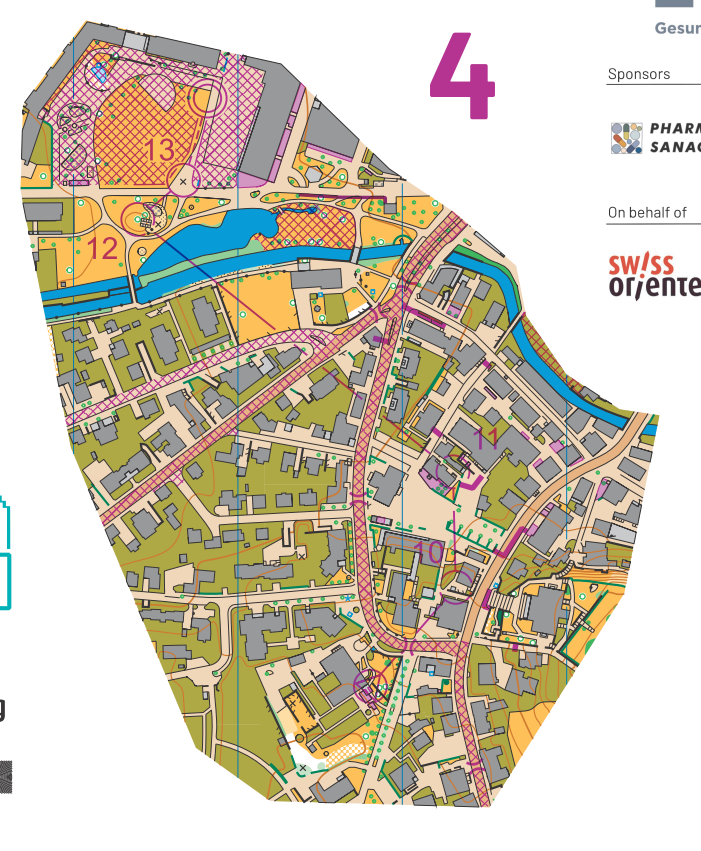
On the race day, it became clear that many runners weren’t prepared for this level of technical and individual orienteering. By the time they reached the central control for the last time, the fields were already widely spread. Nevertheless, the long route choice section allowed for position changes as different options were chosen.
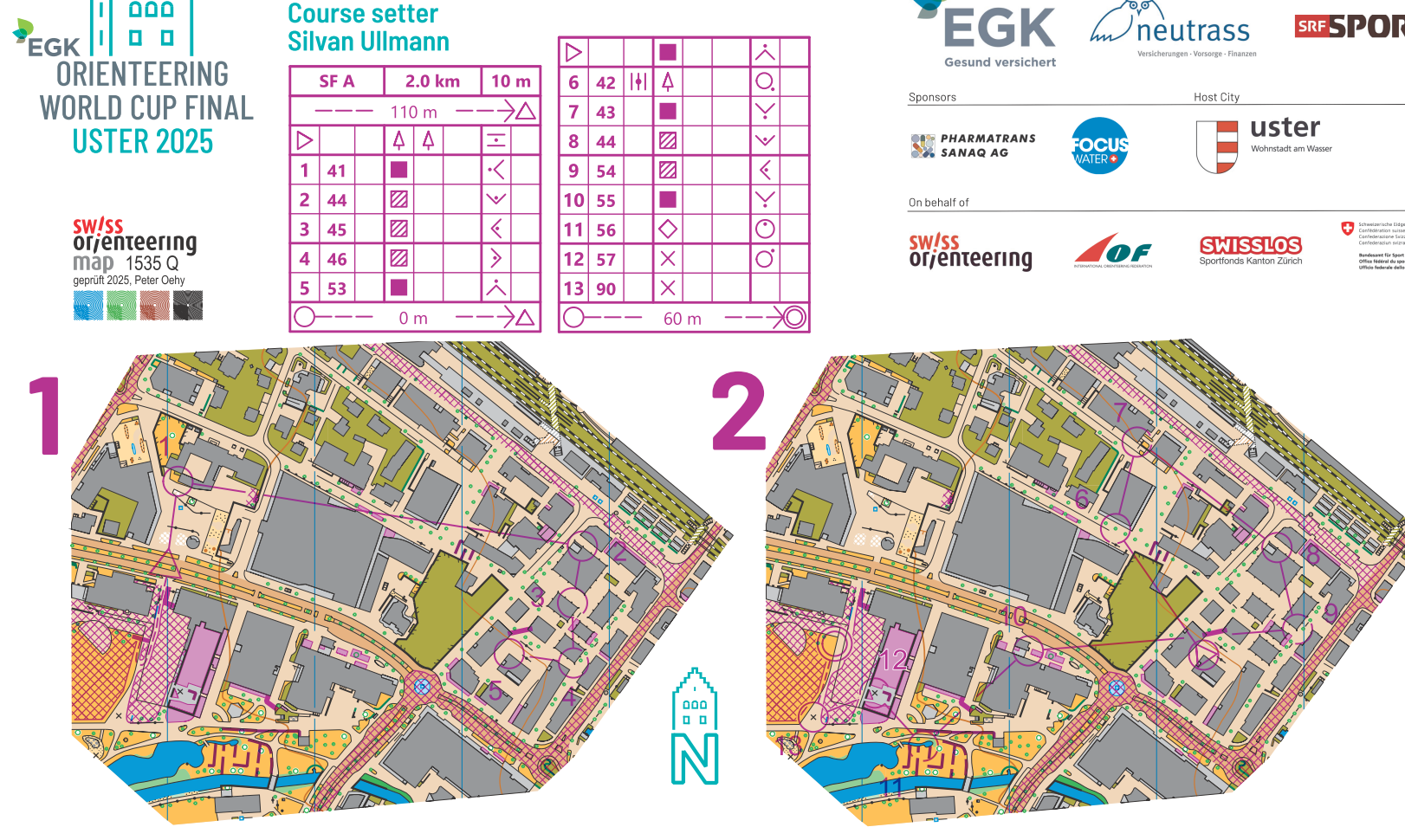
Here is also the first version of the quarter final course:
Semi Final
The semi final courses were at first intended to head into an area further east of the arena. Although these versions included a number of interesting legs, they exceeded the intended KO-S winning time and/or required traffic arrangements that were not realistically feasible.
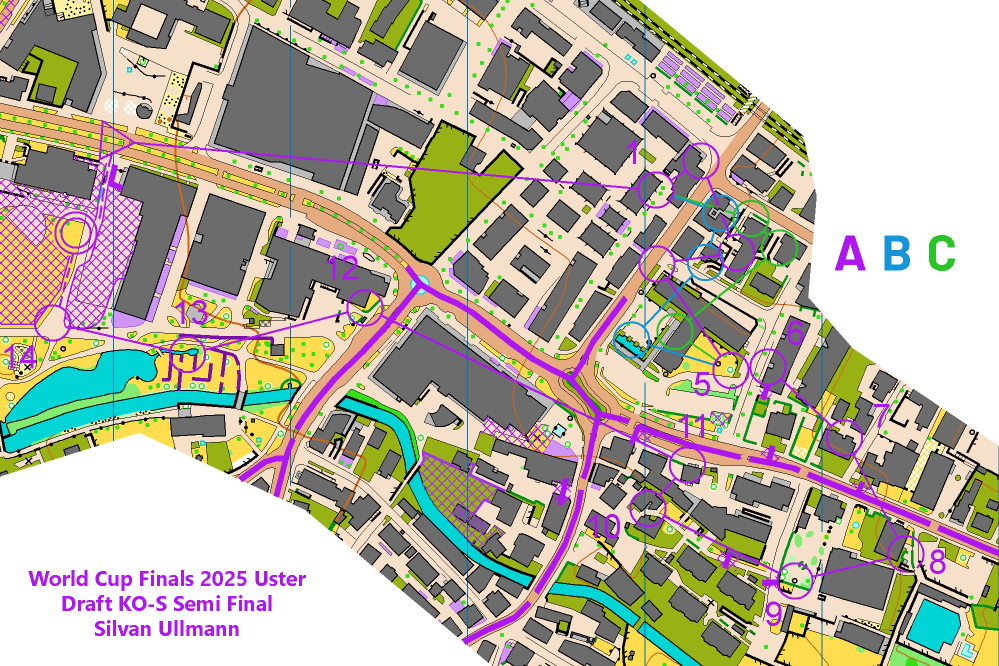
Keeping the course in the central east area slightly reduced the technical difficulty, but made it possible to introduce what I believe is a completely new forking concept: the split-up Runner’s Choice (see explanation below). Normally, when RC forking is used in a KO round, athletes have a clear idea of the course structure: an unforked start, then the RC section, followed by unforked controls to the finish. By instead providing two forked sections and placing the beginning of the RC at a point the athletes would not expect, their flexibility and their ability to read and follow the map carefully was put to the test. To add even more technical challenge, a labyrinth and a short indoor passage were included in the final part.

I was surprised to see many athletes choosing RC option A, which, while technically very easy, was considerably longer than the other two options. Somewhat disappointingly, quite a few runners didn’t manage to take advantage of selecting one of the two shorter options.
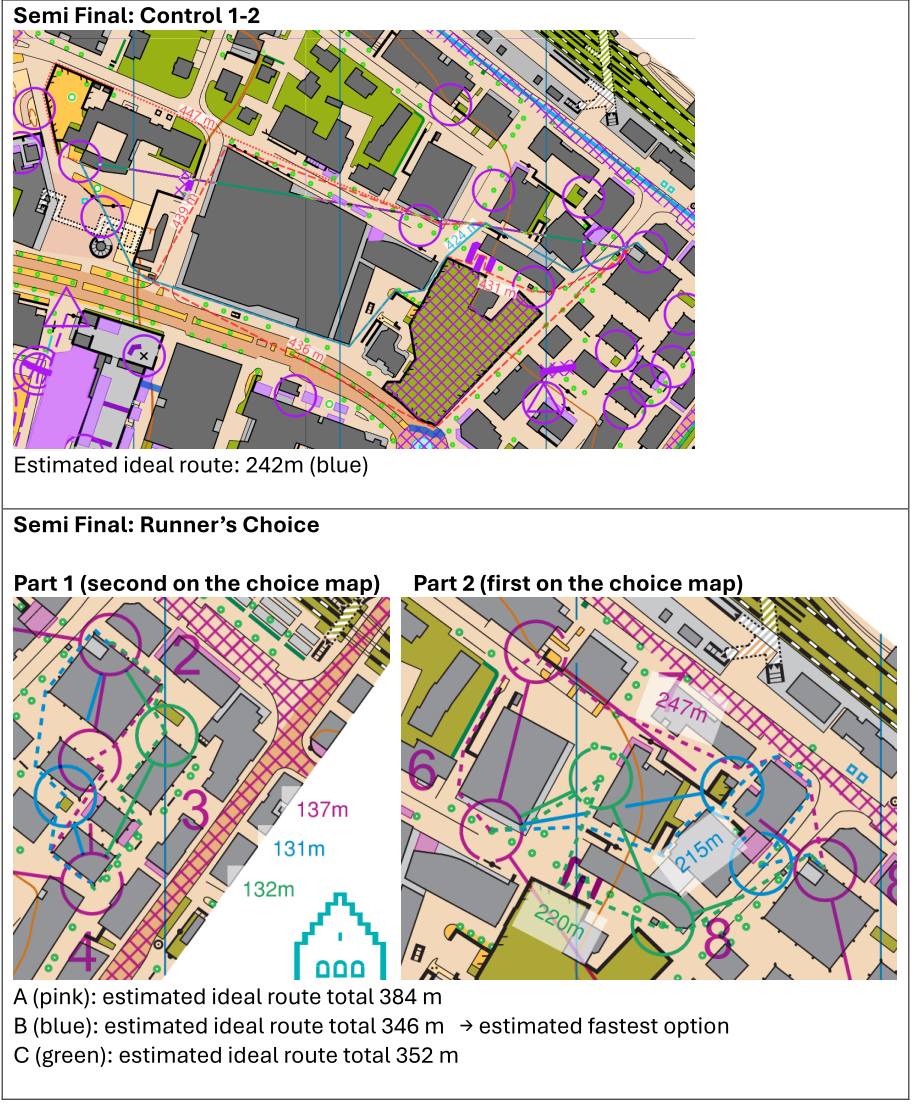
Since the semi final was more physically demanding than the other two and the running speed was high from the beginning, even small mistakes or brief hesitations, costing just a few seconds, were enough to keep some athletes from reaching the final.
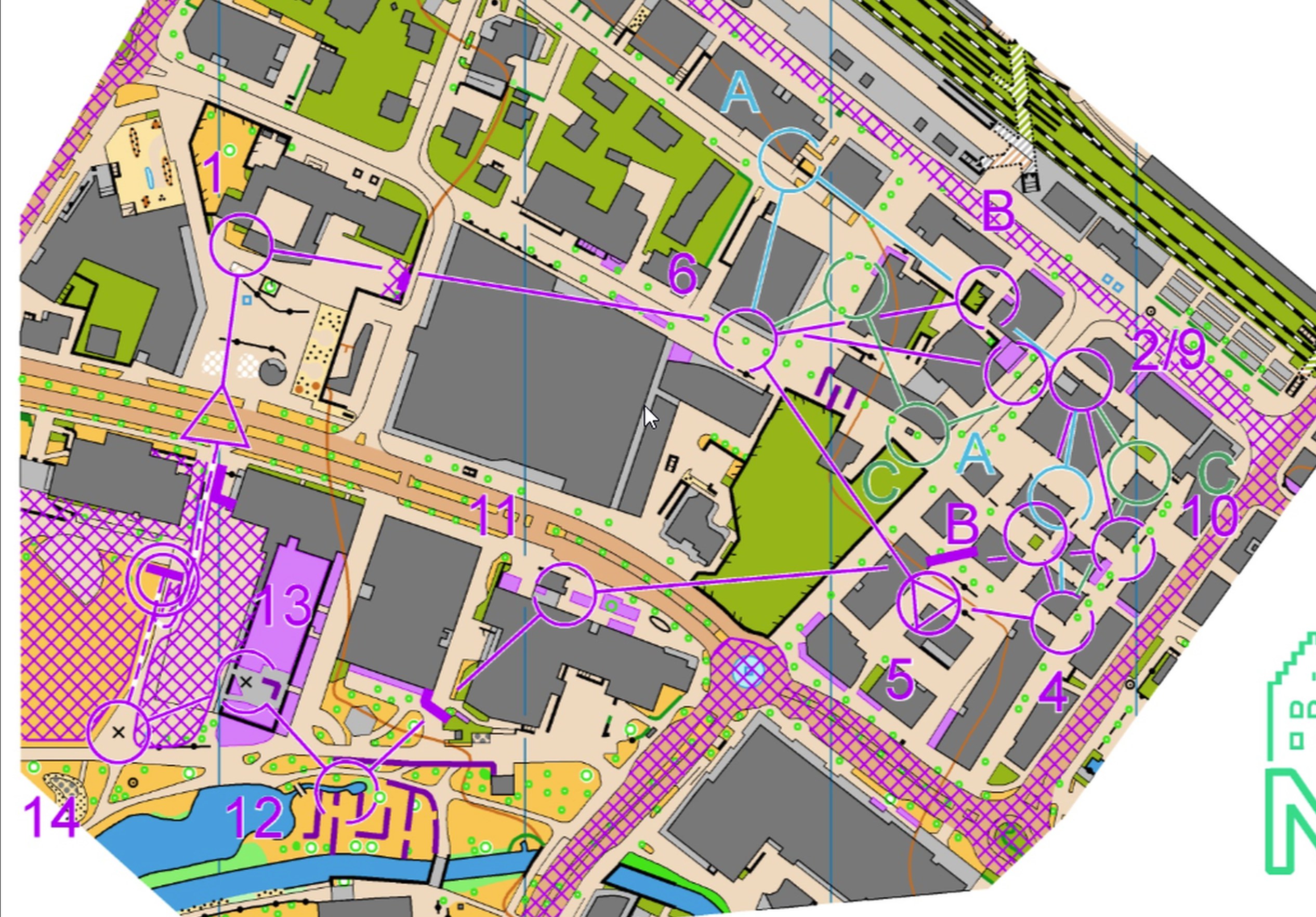
How the split-up RC worked: the athletes first ran to the middle control shared across all RC options, then split into the second half of the RC section (almost equal length for all three options). After two unforked legs, the course continued through what was effectively the first half of the RC section, returning once more to the middle control before finishing on the final unforked controls.
Here is the map with all forkings:
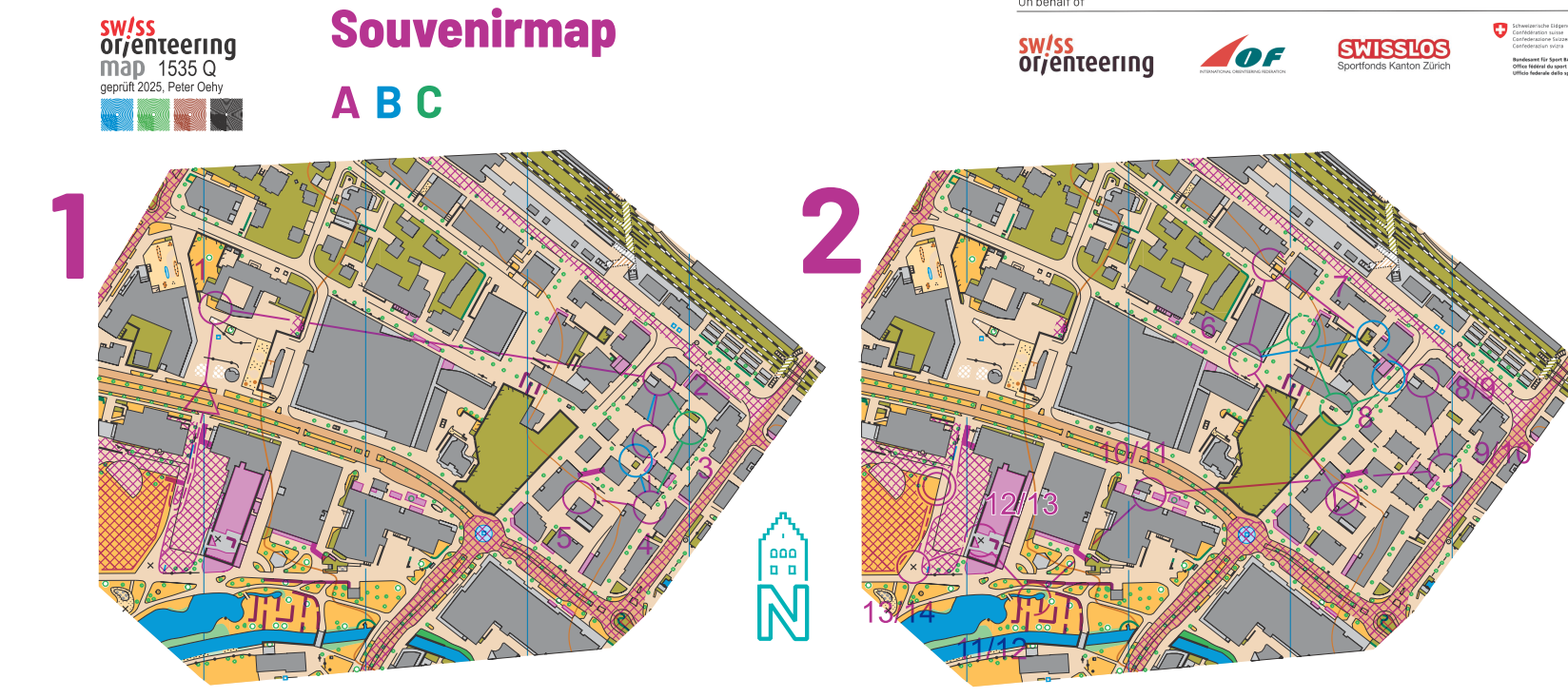
Here is the map for forking A in the semi-final:
Here is also the first version of the semi-final courses:
Final
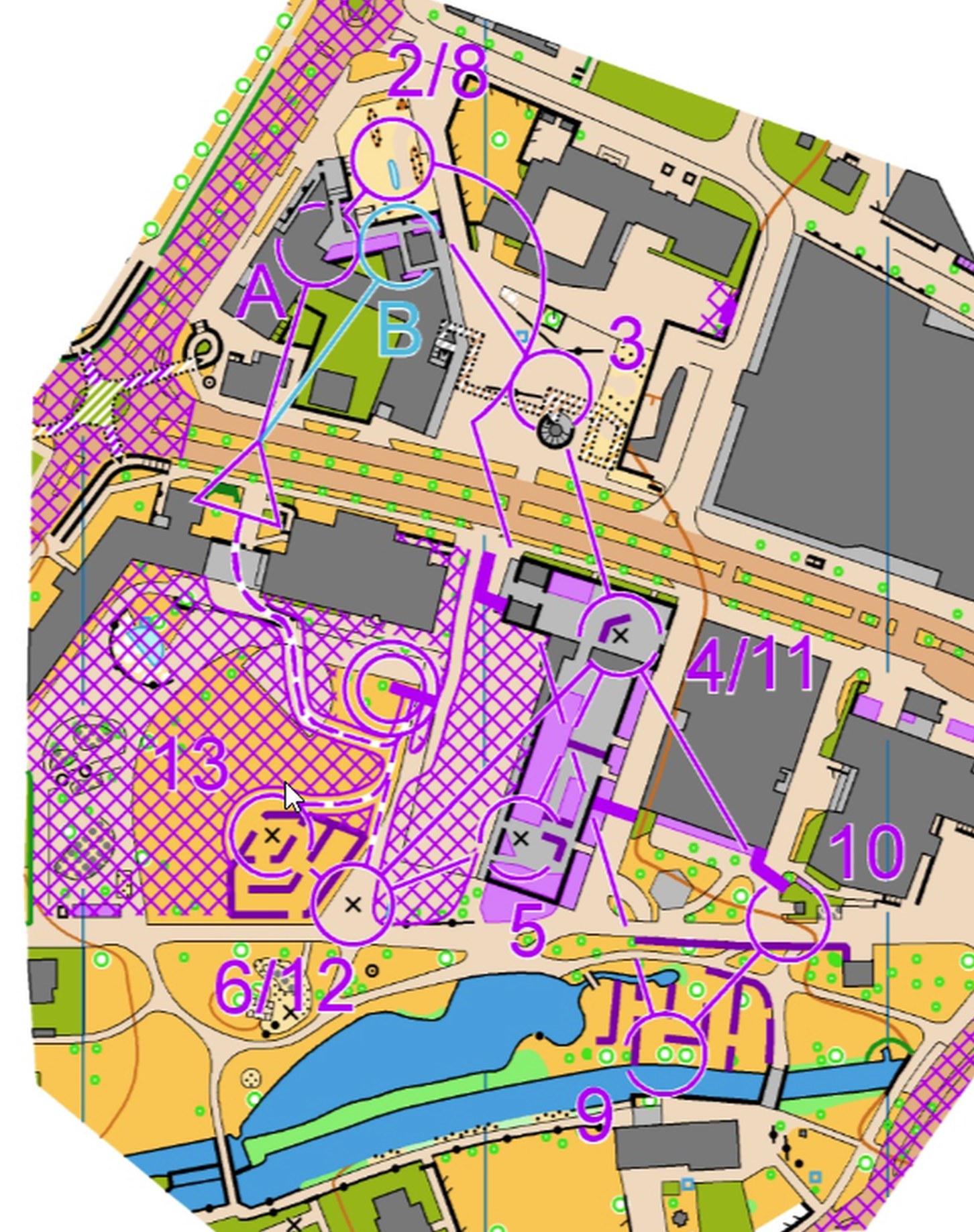
For the Final, I wanted to add another surprise for the athletes, who likely expected an unforked course when they were handed an unspecified map: the arena passage created the opportunity for a two-way forking. To increase the mental pressure even further, I also allowed the arena passages themselves to be used as route choice options.
Here are the two maps the runners on option A got:
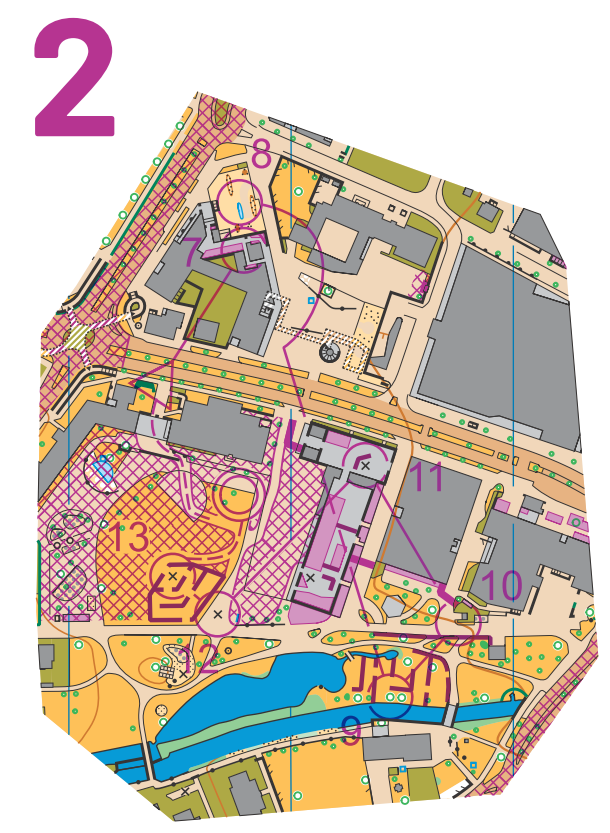
Here are the corresponding two maps with both forkings drawn:
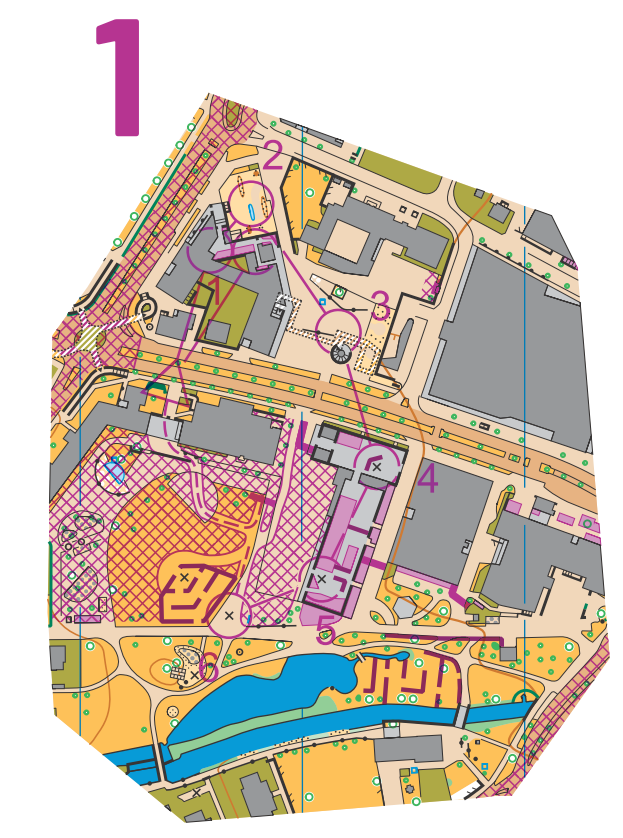
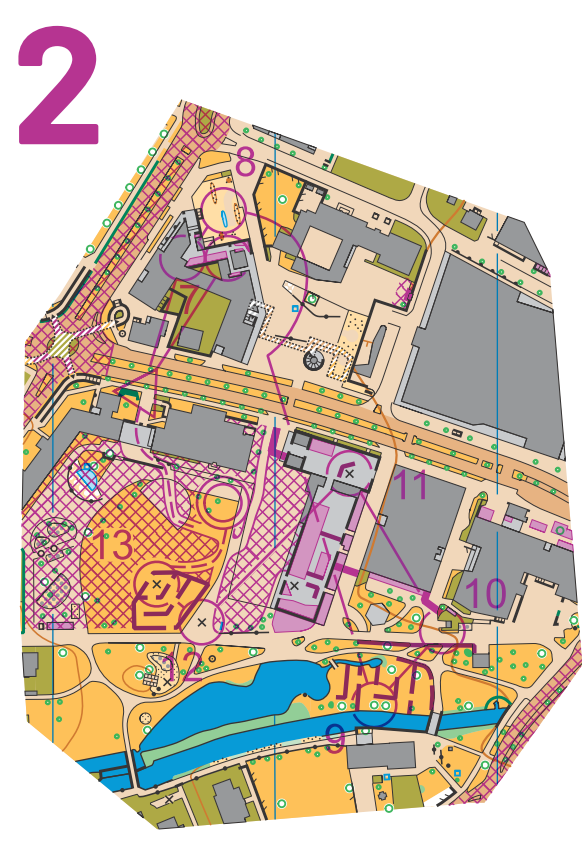
To make the course of the final technically demanding enough, it was essential to gain special access to private properties. In spring, we identified the rooftop terrace of the nearby hotel as a promising option, and they were initially interested in opening it for the 12 finalists. The course and TV concept were almost fully developed when, at the end of July, the property administration overruled and ultimately denied access.
Here is the original version from July [Editors comment: Note that this is a completely different course]:
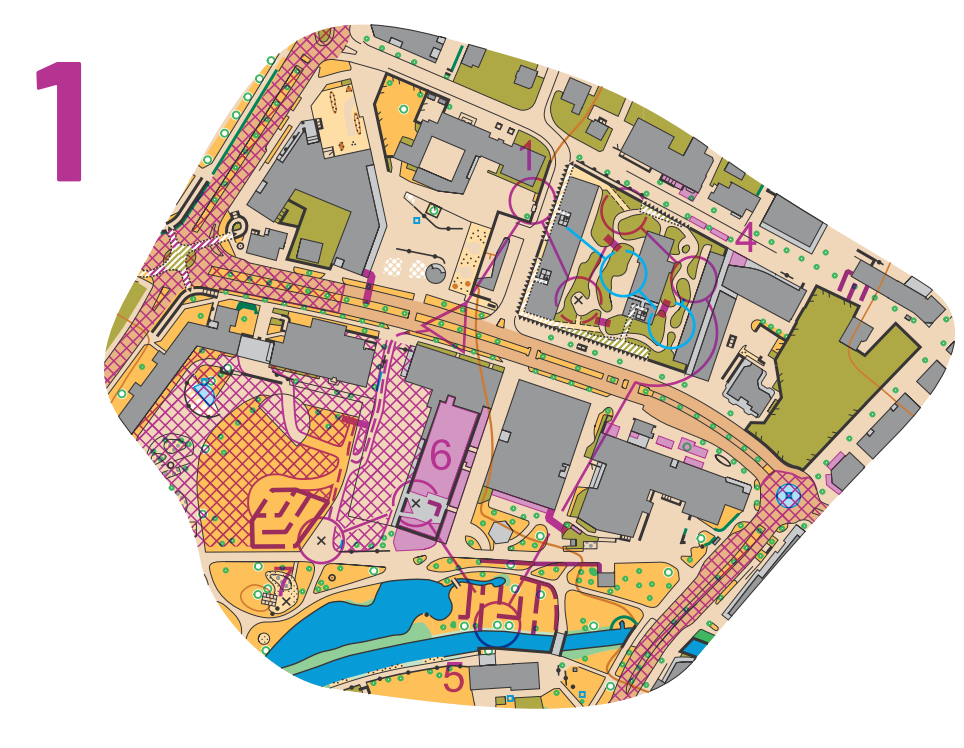
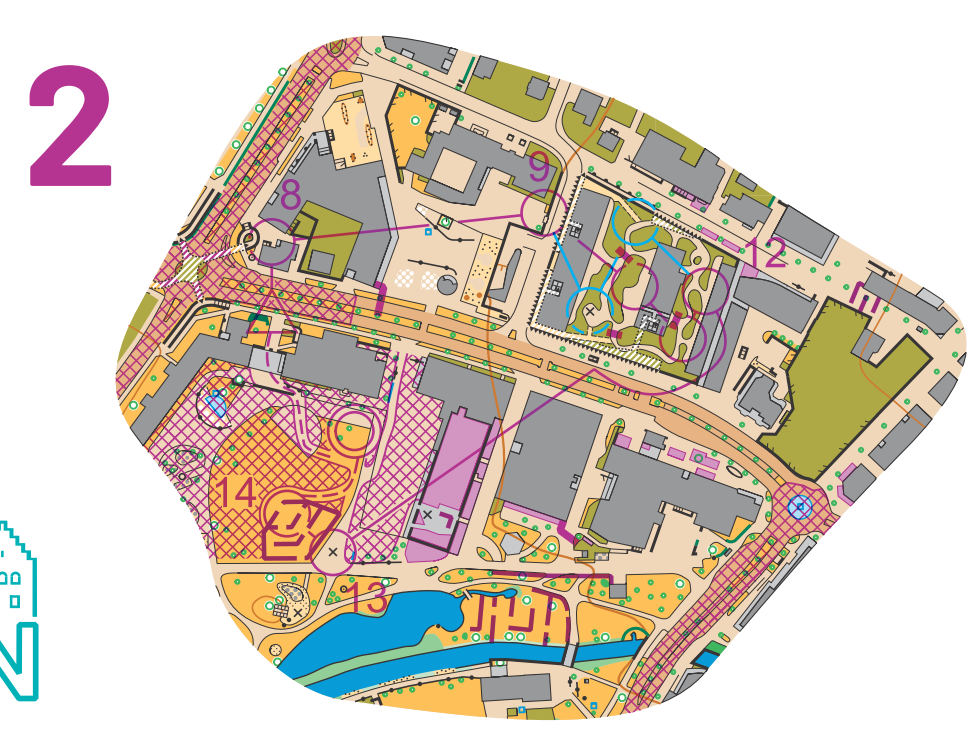
In a last-minute effort, we explored alternatives and were eventually able to use interior spaces of a school and the public parking garage both belonging to a newly completed apartment block. Additionally, the sports and event halls next to the arena were only partially needed for World Cup operations that day, which meant they could also be run through.
It was fascinating to see almost all runners choosing the shortest option to the forked first/seventh control in the school and thus splitting up already at the start point, yet many then failed to exit the building in the optimal direction to the following control.
It was fascinating to see almost all runners choosing the shortest option to the forked first/seventh control in the school and thus splitting up already at the start point, yet many then failed to exit the building in the optimal direction to the following control. Combined with the relatively small differences in the route choice options of the remaining legs, this made for a very exciting race with plenty of position changes. Watching it all come down to the final route choice was, I hope, as satisfying for everyone watching as it was for me.
Q: The many intricate indoor spaces in the final sound technically very challenging to plan. What were the biggest challenges in designing this, and how did you ensure fairness despite the complexity?
Once we had secured the necessary access permissions for the indoor areas, our focus shifted to mapping them as accurately and clearly as possible and ensuring consistent implementation on race day. Due to the unusual nature of some passages, athletes had to be given advance indications of what to expect in the final bulletin and during the team officials’ meeting.
Recently, some concerns had been raised about the difficulty of estimating running speed in indoor environments. I addressed this by carefully designing the route choices and forking variants according to one of the following principles: (1) one clearly optimal route, (2) alternatives with equivalent indoor running, or (3) route choice options through already familiar indoor areas.
I found the legs 9, 11 and 12 in the final (which were designed according to this third principle) particularly interesting. Here, athletes had to apply what they had learned about the runnability of the indoor sections from earlier parts of the course, as well as judge how valuable it was to be able to run parts of a leg by heart.
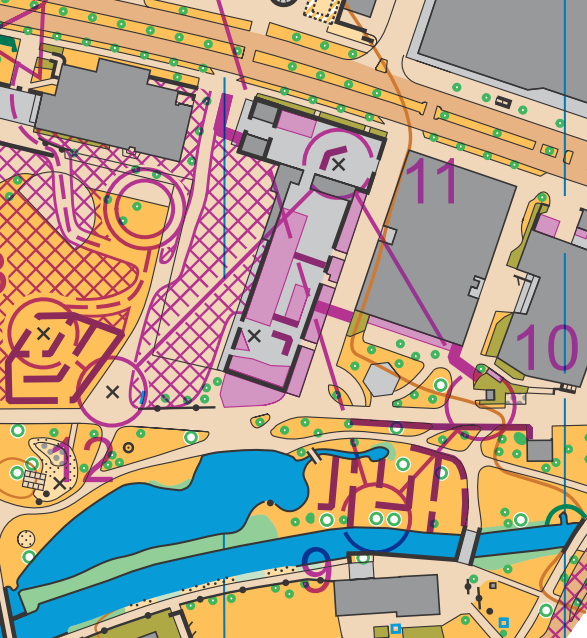
Entrances to indoor areas were intentionally left without taping to maintain the navigational challenge. I considered this to be fair, since the terrain around the arena was already very familiar from previous competitions and KO rounds. To reassure athletes once they were committed to the correct passage, taping began immediately after entering the indoor spaces.
Q: There’s been significant debate about forking in Knock-Out Sprints. Some argue unforked courses are fairer because everyone runs the same course; others say forking prevents “sit and kick” tactics and makes navigation more important. What’s your position, and how would you respond to critics who say forking introduces too much luck?
I agree that certain types of forkings can introduce small elements of unfairness. However, from my perspective, as long as forkings are carefully designed, thoroughly tested, and shown to be well-balanced, they do not create more unfairness than what is already inherent in orienteering as a sport. Maps can never represent the terrain with absolute perfection, and there will always be some level of interaction between athletes and their surrounding environment. For all forkings used in Uster, considerable effort was invested to ensure that each of the variants were as comparable as possible. Field testing showed time differences of less than one second given optimal execution.
I believe it is perfectly fine that some KO rounds are unforked. However, it should not become the default expectation that every course is straight, as this would, in the long run, reduce the level of individual, active orienteering that is at the core of our sport.
Moreover, the small differences introduced by forkings have long been accepted in relay competitions. So why should they not also be used in KO Sprints, especially given their clear and positive contribution to dynamic and exciting race developments?
Q: What advice would you give to future course setters planning Knock-Out Sprints, especially those who might be intimidated by the complexity of creating exciting, fair courses with multiple elimination rounds on the same day?
I believe we are at an important point in the evolution of the Knock-Out Sprint, where every new set of courses has a significant influence. It’s a privilege that course setters have the opportunity to help shape the future of an entire discipline. Even if my courses for the World Cup may have overcompensated slightly for the lack of individual orienteering in the recent races, I hope to inspire many future KO-S course setters to think outside of the box and play with the options that the terrains and forkings provide.
Even if my courses for the World Cup may have overcompensated slightly for the lack of individual orienteering in the recent races, I hope to inspire many future KO-S course setters to think outside of the box and play with the options that the terrains and forkings provide.
Planning courses for a KO-S race is a big challenge, but creating exciting courses that put smiles on the faces of both athletes and spectators is what helps our sport progress, and it’s definitely worth the effort. I hope the IOF shares this view and continues to support organisers, especially less experienced ones, in maintaining a high technical standard at international races. I’m also happy to share my knowledge and experience with anyone who is interested.
Results: Course of the Year 2025
| 1. World Cup Final 2025 Knock-Out Sprint 14240 points |
 . . |
| 2. World Cup Idre Long 2025 11440 points |
 . . |
| 3. Jukola 2025 Leg 3 10810 points |
 . . |
| 4. EOC 2025 | Sprint Final | Men 10160 points |
 . . |
| 5. Maximus O Meeting 2025 Stage 1 M21SE 10110 points |
 . . |
| 6. JWOC 2025 Sprint Men 9650 points |
 . . |
| 7. Finnish Championships Long 2025 M21E 9330 points |
 . . |
| 8. OOcup 2025 – Stage 4 M21E 8600 points |
 . . |
| 9. JWOC 2025 Sprint Relay Leg 1 8010 points |
 . . |
| 10. WOC Long 2025 W21E 7950 points |
 . . |
| 11. VIII Trofeo Extremadura 6980 points |
 . . |
| 12. Czech O-Tour 2025 Žacléř E2 Sprint+Indoor (H21E) 6810 points |
 . . |
| 13. JEC 2025 Long 6710 points |
 . . |
| 14. World Games Sprint Men 2025 6490 points |
 . . |
| 15. Polish Championships Sprint Men 5780 points |
 . . |
| 16. EYOC 2025 – Long M18 5550 points |
 . . |
| 17. Liga Norte Aizkorri Long 5520 points |
 . . |
| 18. 10Mila 2025 Men Leg 4 5260 points |
 . . |
| 19. MEDIA DISTANCIA TORREMOCHA – PICO DE LAS TINIEBLAS – VIII TROFEO 5010 points |
 . . |
| 20. Maze Course Long 4380 points |
 |
“Lucky voter” sponsor prizes
We continue by drawing “lucky voter” sponsor prizes the remaining sponsors (please check out all the sponsors below the results):
- Swiss O-Week (SOW), July 12th – 18th. The Swiss O Week 2026 in Portes du Soleil will take place close to french border, making it truly border-crossing. 6 stages in unique and newly mapped alpine terrain in both Switzerland and France await the runners, all set against the breathtaking backdrop of the Dents du Midi’s dramatic peaks.
- Lucky voter: Johanka Simkova
- 58th Kainuu Orienteering Week (KOW), June 28th – July 3rd. International Orienteering Week set in the beautiful pine forest terrain of Säynäjä, Suomussalmi, Finland – the perfect place to enjoy both orienteering and a summer holiday. The terrain represents the characteristic Kainuu landscape: long ridges, steep sandy slopes, and open mires alternating with areas of gently rolling forested hills.
- Lucky voter 1: Joni Parviainen
- Lucky voter 2: Erik Krijnen
- Lucky voter 3: Sebastián (sebasoi)
- Lucky voter 4: Matti Malinen
- 5+5 Days Sardinia, week 40-41 2026. Sardinia Orienteering – where the map is the key to discovering breathtaking landscapes. The participants will run through ancient woods and untouched mountains, challenging themselves on terrains that tell a thousand-year-old history. White beaches and a crystal-clear sea that will give the runners a dream view at the start and finish of every stage.
- Lucky voter 1: Brent Key
- Lucky voter 2: Tore Sandvik
- 3TRE Orienteering + 5 Days Italy 2026, June 26th – July 4th. Eight days of Italian alpine orienteering combining 3Tre Orienteering in Madonna di Campiglio (June 26–28) and 5 Days Italy 2026 in Val di Sole (June 29–July 4). 3Tre offers a night sprint in the village centre beside the famous 3Tre ski slope and two forest races in the Brenta Dolomites, a UNESCO World Heritage site. 5 Days Italy then moves to new maps in Val di Sole and Val di Pejo, with varied stages around Passo Tonale and Lago dei Caprioli, and a final sprint in the historic village of Ossana.
- Lucky voter 1: Matthias Kretzschmar
- Lucky voter 2: Klára Lukešová
- Maximus O Meeting: February 20th – 24th 2026 (Spain). The 7th edition of Maximus O Meeting is ready to deliver another unforgettable orienteering experience in the heart of Spain. From February 20 to 24, 2026, participants will enjoy four high-quality races, each mapped specifically for the event, combining technical navigation, physical challenge, and stunning landscapes.
- Lucky voter: Rosina Salzmann
Here are the “lucky voters” from the earlier rounds:
- Sudety Cup 2026, July 30th – August 2nd 2026. 4- day orienteering challenge in the beautiful Orlickie Mountains in Poland, set in rarely visited, technically demanding terrain.
- Lucky voter 1: Dirk Goosens
- Lucky voter 2: Veronika Podlipná
- Lucky voter 3: Joseph Segalla
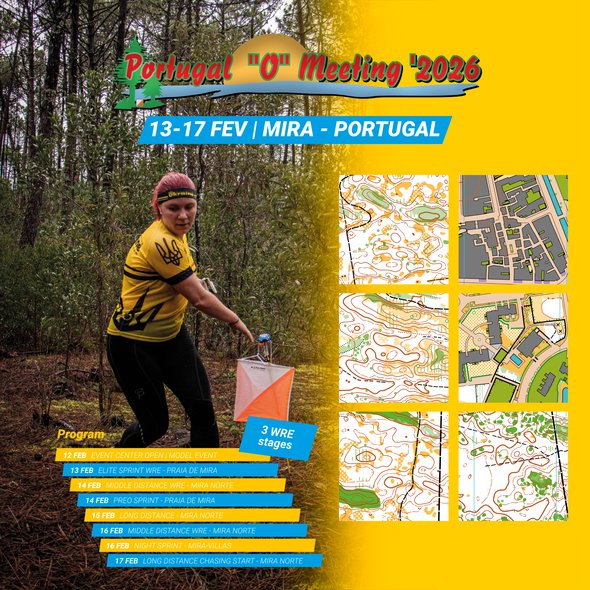
- Portugal O-meeting. February 13th-17th. POM 2026 will give the possibility to have 7 races in 5 days, including 3 WRE stages, in the beautiful coastal region of Mira. The forest stages will be held on a new 23 km2 map, in enjoyable sand-dunes pine forests.
- Lucky voter 1: Quentin Moulet
- Lucky voter 2: Ville Lampinen
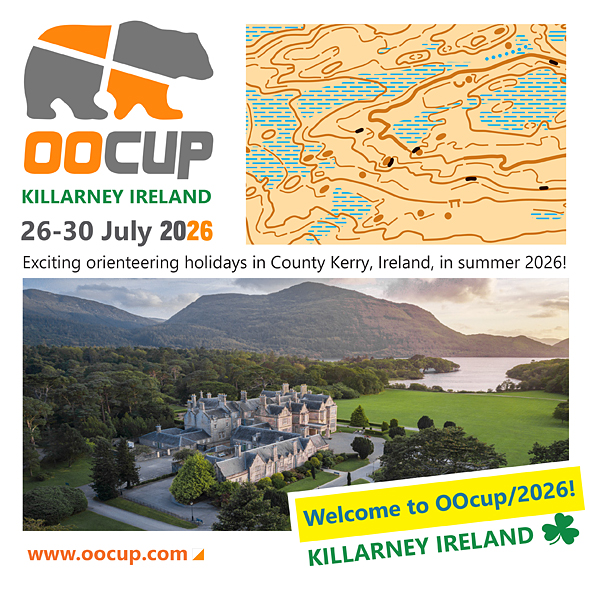
- OOCup, July 26th – 30th 2026. Stunning landscapes, hospitable people, lakes, castles, cool pubs and some super nice orienteering terrain… you will find all that and much more around Killarney national park in Kerry county in Ireland during OOcup/2026!
- Lucky voter 1: Martin Jansson
- Lucky voter 2: Ana Toledo
- Software sponsor: OCAD Orienteering 3-year Single User license. OCAD Orienteering is all you need to produce orienteering maps and set orienteering courses – also perfect in combination with the new OCAD App!
- Lucky voter: Fredrik Bjernulf
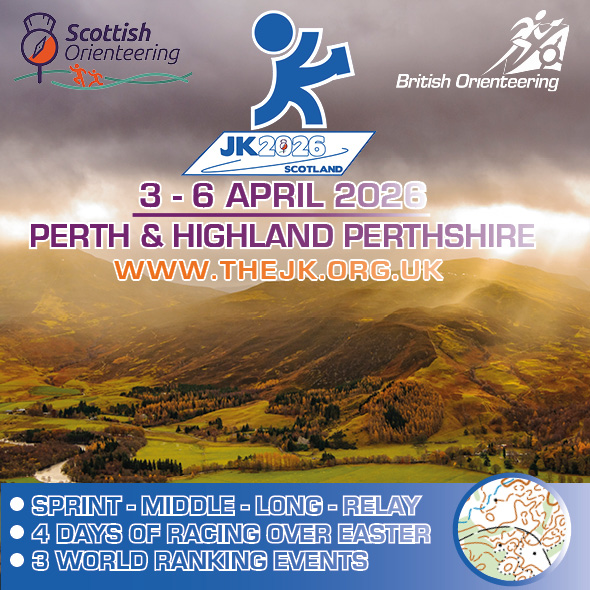
- JK International Festival of Orienteering, April 3rd – 6th. The UK’s biggest Orienteering Festival returns in 2026, in Scotland for only its second visit there in 25 years! Three individual stages (Sprint, Middle, Long) which are all World Ranking for the elite, followed by an exciting Relay competition with categories for all ages.
- Lucky voter: Paul Wimberley
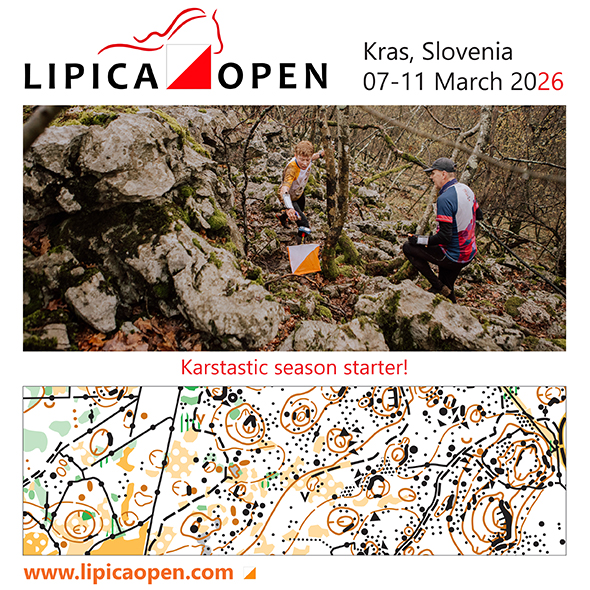
- Lipica Open, March 7th – 11th 2026. Traditional season starter in the region that gave Karst its name. Enjoy Slovenian karst terrain already in March.
- Lucky voter 1: Carlit Tolkko
- Lucky voter 2: Christoph Furer
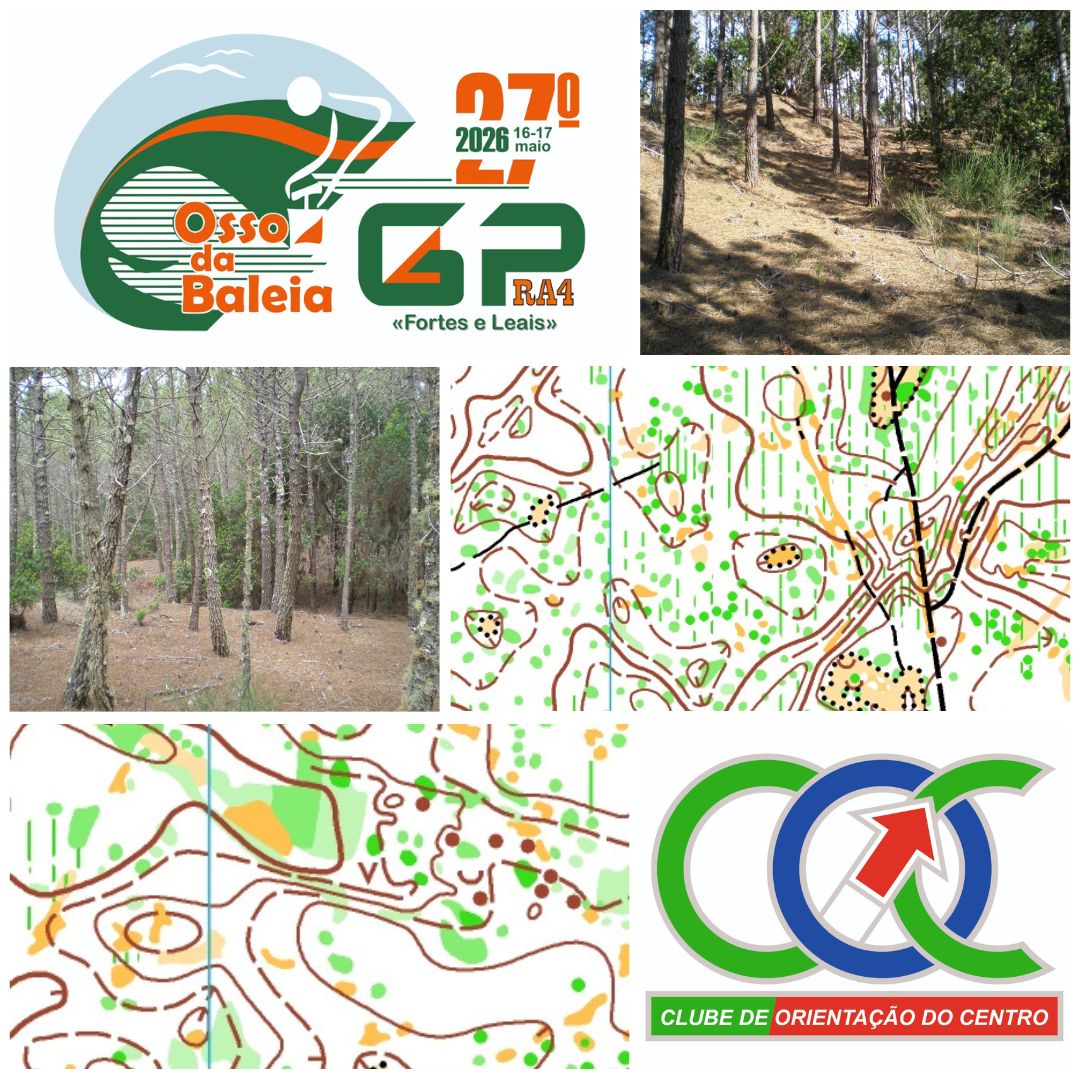
- 27th Grand Prix of the 4th Artillery Regiment, May 16th -17th 2026. An exciting 2-day competition in forest pine tree, sand dune terrain in the coastal area between Figueira da Foz and Nazaré in Portugal- including a sprint moment.
- Lucky voter: Maria Florencia Llera
- Kapa 3days 2026. July 3rd-5th. The largest orienteering event in the Baltics with over 2000 participants annually, in one of the most technical and demanding terrains in Latvia, featuring detailed contours, complex vegetation, and subtle route choices.
- Lucky voter 1: Arild Andersen
- Lucky voter 2: Marek Karm
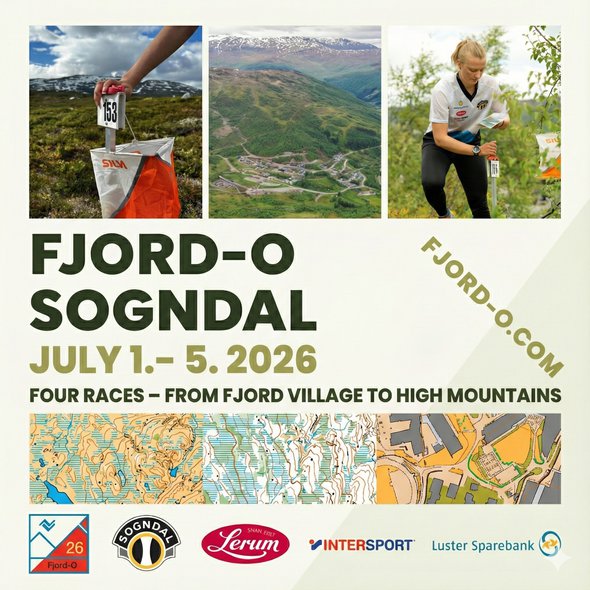
- Fjord-o 2026. July 1st – 5th. An orienteering week by the beautiful Sognefjord in Norway, featuring three forest stages in demanding, fast running mountain terrain with stunning views, and one sprint stage at the fjord.
- Lucky voter: Elin Neuenschwander
All lucky voters will receive an e-mail about how to claim the “lucky voter”-prize in a few days time.
Event sponsor: Maximus O Meeting, February 20th – 24th 2026 (Spain)
- Prize offered: Package for two people including entries to Maximus O Meeting 2026, full-board accommodation for 4 nights at Hotel Maximus in Las Navas del Marqués, and Maximus promotional gifts. Valued at 1,000 EUR. Transferable to another person.
- More information: The 7th edition of Maximus O Meeting is ready to deliver another unforgettable orienteering experience in the heart of Spain. From February 20 to 24, 2026, participants will enjoy four high-quality races, each mapped specifically for the event, combining technical navigation, physical challenge, and stunning landscapes. Maximus O Meeting is more than just a competition — it is the February gathering for orienteers to test their form, enjoy premium terrain, and immerse themselves in the unique atmosphere of Spanish winter training. After being awarded “Course of the Year 2024,” the team is committed to maintaining the highest standards and continuing to create world-class courses in the years to come. Website: www.maximusorientacion.com/mom
Event sponsor: 58th Kainuu Orienteering Week (KOW), June 28th – July 3rd (Finland)
- Prize offered: 4 packages, each consisting of 2 free participations for the whole week in any class (competition classes or open courses) at Kainuu Orienteering Week 2026. Total value up to 920 EUR. Transferable to other persons.
- More information: Open and International Orienteering Week in Säynäjä, Suomussalmi, Finland. Welcome to the beautiful pine forest terrain of Säynäjä, Suomussalmi – the perfect place to enjoy both orienteering and a summer holiday. The competition area is located about 15 km southeast of Suomussalmi, right next to the Säynäjäsuo Mire Conservation Area. The terrain represents the characteristic Kainuu landscape: long ridges, steep sandy slopes, and open mires alternating with areas of gently rolling forested hills. High-quality maps and expertly designed courses offer suitable orienteering challenges for everyone – from beginners to elite athletes. World-class event organization and the diverse outdoor opportunities of Suomussalmi promise an unforgettable orienteering and holiday week in the wild heart of Northern Kainuu. Come and experience the most memorable week of summer 2026 in Kainuu’s ruggedly beautiful wilderness – where the forest challenges you and the scenery rewards you.Kainuu Orienteering Week is the biggest Finnish orienteering week, and it has been held annually since 1966 in Kainuu Region, Finland. Competition categories are H/D8-95. In open courses KOW offers 10 different skill and distance levels in total. See more: rastiviikko.fi (#kainuuoweek|#kainuuorienteeringweek|#KOW) Experience a memorable orienteering week in Suomussalmi! Note also the 6th official Kainuu MTBO Week 28 June – 3 July in Suomussalmi – come and enjoy the best MTBO terrains and great landscapes of Kainuu! The following entry steps are: 28th Feb 2026 / 31st May 2026 / 7th June 2026. For more information see www.rastiviikko.fi.
Event sponsor: 5+5 Days Sardinia, week 40-41 2026 (Italy)
- Prize offered: 2 packages, each for 2 entries for 5+5 Days Sardinia 2026 (either for week 40 or week 41, as you prefer). Value 800 EUR. Transferable to other persons.
- More information: Sardinia Orienteering: Adventure Awaits Between Sky and Sea! Are you ready to combine your passion for orienteering with the wonder of a unique land? Join us in Sardinia, where the map is your key to discovering breathtaking landscapes. You will run through: Ancient woods and untouched mountains, challenging yourself on terrains that tell a thousand-year-old history. White beaches and a crystal-clear sea that will give you a dream view at the start and finish of every stage. More than a race, an active holiday! Enjoy our generous climate and the Sardinian sun that makes every moment special. And after the sporting challenge, the prize is the celebrated Sardinian hospitality: Genuine and flavourful food. Unmissable tastings of fine local wines and the excellent extra virgin olive oil. Map, compass, and good taste: the perfect orienteering is in Sardinia! Website: https://www.orienteering.it/events/
Event sponsor: 3TRE Orienteering + 5 Days Italy 2026, June 26th – July 4th (Italy)
- Prize offered: 2 packages, each of 2 entries for a combined package for 3TRE Orienteering + 5 Days Italy 2026 (both events together for each person). Value around 800 EUR. Transferable to other persons.
- More information: Eight days of Italian alpine orienteering combining 3Tre Orienteering in Madonna di Campiglio (June 26–28) and 5 Days Italy 2026 in Val di Sole (June 29–July 4). 3Tre offers a night sprint in the village centre beside the famous 3Tre ski slope and two forest races in the Brenta Dolomites, a UNESCO World Heritage site. 5 Days Italy then moves to new maps in Val di Sole and Val di Pejo, with varied stages around Passo Tonale and Lago dei Caprioli, and a final sprint in the historic village of Ossana. Together they create a compact O-holiday with strong international fields, high-quality maps and plenty of chances to enjoy the Trentino mountains before and after the races. Websites: www.3treorienteering.it and www.5daysitaly.com
Event sponsor: Swiss O-Week (SOW), July 12th – 18th (Switzerland)
- Prize offered: Competition package for two people: Entry for two people at the Swiss O Week 2026 in Portes du Soleil, including all mountain railway tickets to get to the stages from the competition centre. Value 500 CHF. Transferable to other persons.
- More information: The Swiss O Week 2026 in Portes du Soleil will take place close to french border, making it truly border-crossing. 6 stages in unique and newly mapped alpine terrain in both Switzerland and France await you, all set against the breathtaking backdrop of the Dents du Midi’s dramatic peaks. Read more at the website https://swiss-o-week.ch/en or follow us on Facebook and Instagram.
Event sponsor: Sudety Cup 2026, July 30th – August 2nd 2026 (Poland)
- Prize offered: 3 packages, each for 2 people – consisting of entry to Sudety Cup 2026 and including official Sudety Cup orienteering shirt. Total value up to 660 EUR. Transferable to other persons.
- More information: Join us in 2026 from July 30th to August 2nd in the beautiful Orlickie Mountains for Sudety Cup – a 4-day orienteering challenge set in rarely visited, technically demanding terrain. Each of the four stages will showcase a different character of this unique region, offering a fresh test of navigation and endurance every day. Sudety Cup includes a WRE stage, attracting strong international competitors, while the kid’s zone and Mini-O courses ensure a welcoming, family-friendly atmosphere. With the JWOC 2027 taking place just a few kilometers away, the event is a perfect chance to explore terrain similar to what awaits athletes at the championships. In 2026, Sudety Cup also offers an ideal training opportunity before the World Masters Orienteering Championships, held in southern Poland the following week. With the same mapmakers involved in both Sudety Cup and WMOC, it is the perfect way to combine great racing with highly relevant and purposeful preparation. Webpage: https://sudetycup.pl/
en/
Event sponsor: Portugal O-meeting. February 13th-17th (Portugal)
- Prize offered: 2 packages, each one for 2 people, consisting of Portugal “O” Meeting 2026 entry fees (Model vent, Sprint WRE, Night Sprint, PreO Sprint, 2 * Middle WRE & 2 * Long) and 4 training maps (for each) provided by O-Portugal.pt. Total value up to 660 EUR. Transferable to other persons.
- More information: POM 2026 will offer you the possibility to have 7 races in 5 days, including 3 WRE stages, in the beautiful coastal region of Mira! The forest stages will be held on a new 23 km2 map, deep into our most enjoyable sand-dunes pine forests. Besides, www.O-Portugal.pt will offer you the best training maps one can have and will help you to find the perfect accommodation for your needs! Website: https://pom.pt/2026/en
Event sponsor: OOCup, July 26th – 30th 2026 (Ireland)
- Prize offered: 2 packages, each for 2 people – consisting of: Entry for the complete 5 days OOCup competition. Total value around 440 EUR. Transferable to other persons.
- More information: Stunning landscapes, hospitable people, lakes, castles, cool pubs and of course some super nice orienteering terrain… you will find all that and much more around Killarney national park in Kerry county during OOcup/2026! We plan to use 3 distinct terrain types during the week; 1 stage in sand dunes, 3 stages typical Irish intricate mountain terrain, 1 stage in forest around Muckross garden in Killarney national park. Possibility to take part in the event car free is planned! More at oocup.com
Software sponsor: OCAD Orienteering 3-year Single User license
- Prize offered: One 3-year runtime Single User license for the software “OCAD Orienteering”. Value about 435 EUR. Transferable to other person (before activation).
- More information: OCAD Orienteering: All you need to produce orienteering maps and set orienteering courses. Perfect in combination with our new OCAD App! The OCAD App is a further development of the OCAD Sketch App and allows not only sketching but also direct editing of the map. Background maps, GPS positioning, and a compass can be used to determine your exact position in the terrain. Map projects can be transferred from the Desktop version of OCAD to the OCAD App and synchronized again after mapping. Discover the OCAD App at https://www.ocad.com/app

Event sponsor: JK International Festival of Orienteering, April 3rd – 6th (UK)
- Prize offered: A package of 4 starts at the three individual races on 3-5 April (Sprint, Middle, Long). For 4 seniors this is a package value of 400 EUR. Transferable to other persons.
- More information: The UK’s biggest Orienteering Festival returns in 2026, in Scotland for only its second visit there in 25 years! Three individual stages (Sprint, Middle, Long) which are all World Ranking for the elite, followed by an exciting Relay competition with categories for all ages. The stunning surroundings of Highland Perthshire promise to deliver a fantastic backdrop for competitors to enjoy as they take on some of Scotland’s best orienteering terrain. Come and visit a competition next door to the mountain where contours were ‘invented’, surely somewhere every orienteer should visit! Webpage: https://www.thejk.org.uk/
Event sponsor: Lipica Open, March 7th – 11th 2026 (Slovenia)
- Prize offered: 2 packages, each for 2 people – consisting of entry to complete 5 Day Lipica Open competition. Value up to about 340 EUR. Transferable to other persons.
- More information: Traditional season starter in the region that gave Karst its name. Enjoy Slovenian karst terrain already in March. More at www.lipicaopen.com
Event sponsor: 27th Grand Prix of the 4th Artillery Regiment, May 16th -17th 2026 (27º GP RA4)
- Prize offered: Entry package for 5 persons, for 27º GP RA4. The total value of the prize is EUR 285. Transferable to other persons.
- More information: 27º GP RA4 competition will be held in a forest pine tree, dune sand terrain – “Praia do Osso da Baleia”, in the coastal area between Figueira da Foz and Nazaré. Our club organized there one WRE in February 2013. We will offer 2 technical and challenging forest courses. Also a sprint moment in the small town of Pombal. All new maps!! More information here: https://eventos.coc.pt/27gpra4/ (information to be updated during December; see also the portuguese registration platform)
Event sponsor: Kapa 3days 2026. July 3rd-5th (Latvia)
- Prize offered: Two family entry packages to Kapa 3days, each including entry for two adults and two children, tent space at the event campsite, and a car parking voucher. Approximate total value: 250 EUR. Fully transferable.
- More information: Kapa 3days, the largest orienteering event in the Baltics with over 2,000 participants annually, celebrates its 39th edition! In 2026, we head to Tartaks in eastern Latvia – one of the most technical and demanding terrains in the country, featuring detailed contours, complex vegetation, and subtle route choices. The event center will offer a kindergarten, a relaxed atmosphere with evening live music, and an exciting sprint relay on Day 2. Bring your family to enjoy high-level orienteering and the stunning natural landscapes of Latgale! This year’s event page: https://2026.kapa.lv. Facebook page: https://facebook.com/Kapa3days.
Event sponsor: Fjord-o 2026. July 1st – 5th (Norway)
- Prize offered: 1 package, consisting of 2 free participations for the whole Fjord-O (4 competitions) in any class (competition classes or open courses). Total value up to 200 EUR.
- More information: International Orienteering Week in Sogndal, Norway. Enjoy Sprint in Sogndal village by the beautiful Sognefjord. Three forest stages in demanding, fast running and stunning views in mountains and birch forest. Enjoy the rest day with fjord cruise, glacier or mountain hiking, or mountain biking. Team challenge for the kids. Eirik Langedal Breivik will be the course setter for races 3 and 4, world champion on middle distance and relay at the 2025 World Championships in Kuopio!We can offer stunning scenery and newly drawn maps. Fast running forest and mountain terrain. Overall competition with one sprint and three forest distances. Short distance to the races: Day 1: Sprint in Sogndal center, Day 2-4: 2x long distance, and middle distance– arena Sogndal Ski Center – only 15 min from Sogndal. Accommodation at O-camp at Stedje camping, in apartments on campus, campsites or in Sogndal Ski Center (arena days 2-4). Touch Free EMIT stamping system every day. The following entry steps are: 15th March 2026 / 22d June 2026 / day before race day. Webpage: https://www.fjord-o.com/

Fantastic KO-courses, which were a joy to follow on TV. Forking is certainly necessary to create interesting KO-sprints, and here it was executed in a superb way (though I still struggle to really understand the system for the semifinals;-)).